About Jyeshtha Gauri Puja
Last updated:
Jyeshtha Gauri Puja is a Maharashtrian festival celebrated mostly among the people of Marathi community. In Maharashtra, this ritual is observed during the Ganesha Chaturthi festival, with Goddess Gauri arriving in homes one or two days before the installation of Lord Ganesha. Goddess Gauri is considered to be an incarnation Goddess Parvati, the divine consort of Lord Shiva and the mother of Lord Ganesha. Goddess Gauri is revered as the deity of fertility, marital bliss and prosperity. Among the Koli community, She is especially worshipped as the protector of homes and livelihoods, believed to bless them with abundance and harmony in life. In the coastal regions of Maharashtra, Goddess Gauri is generally worshipped as a single deity, i.e., Jyeshtha Gauri. However, in the interior and southern plateau regions of Maharashtra, two forms are worshipped, Jyeshtha Gauri and Kanishta Gauri, where Kanishta Gauri is often identified with Mahalakshmi. In coastal areas, Jyeshtha Gauri is usually represented by a metal facemask, which is placed on a humanlike structure and adorned with traditional Koli attire and jewelry. Koli women offer a new Nauvari Saree to the Goddess every year as part of the tradition. During the tenday Ganeshotsava, Gauri Puja is celebrated over three days. On the first day, the Avahana, arrival and installation of the Goddess take place. The second day is dedicated to the main Puja and rituals and on the third day, the Visarjan is performed. Women play a central role in all these rituals. Dressed in traditional attire and ornaments, they purify the home, perform the Puja and prepare Naivedya, i.e., sacred food offerings with deep devotion. They also sing traditional Bhajans and folk songs in praise of the Goddess throughout the celebrations.
Deities & divine forms
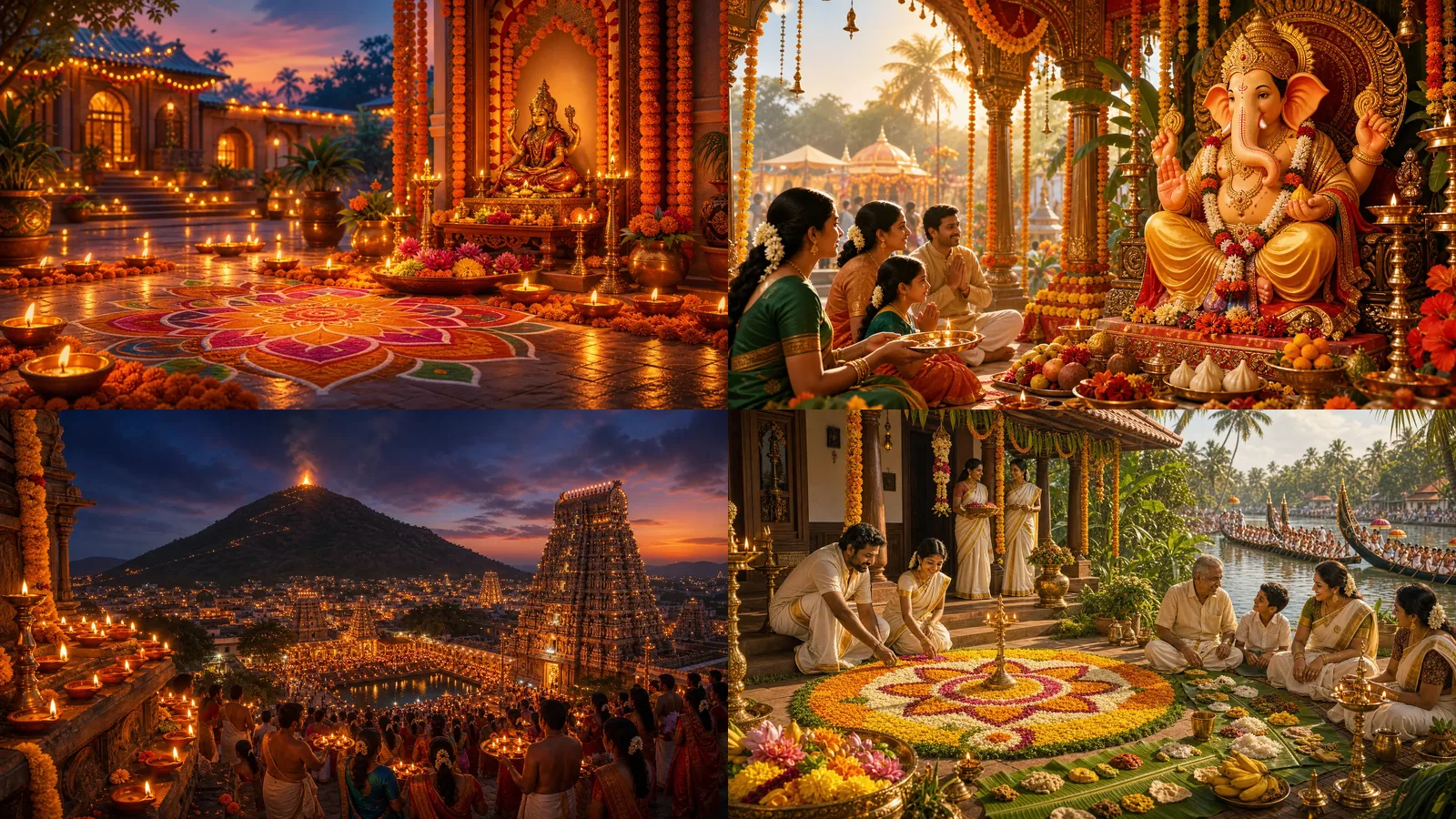
On the first day, family members come together to clean and decorate their homes and community spaces. Special attention is given to adorning the area where the idol of the Goddess will be installed, using a variety of flowers, Rangoli designs and Diya. The arrival of the Goddess is celebrated with music, singing, dancing and instrumental performances. Kula Purohita, i.e., the family priest ceremoniously brings the idol into the house, taking it around the home before installing it on an elevated platform. At the auspicious , the idol is installed and invoked with sacred Mantras, followed by a grand Aarti in Her honor. On the second day, the main Puja is performed. Typically, a Brahmin priest is invited to conduct the rituals in a detailed and traditional manner. The Kalash holds special significance during this Puja. It is placed before the Goddess, decorated with mango leaves and topped with coconut. This PurnaKalash is considered a symbol of Mother Earth or the divine womb. In ritual symbolism, mango leaves represent fertility, the coconut signifies prosperity and the water inside the pot is likened to Amrita, the nectar of immortality. On the main day of worship, sixteen varieties of Naivedya are presented to the Goddess. These include Modak, the favorite sweet of Lord Ganesha, and Kheer, among other traditional sweets. Great emphasis is placed on purity and cleanliness during the preparation of Naivedya. The kitchen, utensils and the individual preparing the offerings must all be properly purified. The offerings are always Sattvic, free from onions, garlic and other ingredients considered impure for religious rituals.
How to celebrate Jyeshtha Gauri Puja 2026
Jyeshtha Gauri Vrata KathaThe very popular Jyeshtha Gauri Vrat Katha is described here. This story is based on a poor Brahmin who didn't even have enough money to invoke Goddess Gauri in his house. Saddened by this, the Brahmin was about to end his life when Goddess Gauri appeared before him as an old woman. Jyeshtha Gauri AvahanaJyeshtha Gauri Avahana is a very popular Hindu festival which is mainly observed in Maharashtra. On this day, Goddess Jyeshtha Gauri is invoked and invited into homes for three days of worship. On the following day, the Jyeshtha Gauri Puja is performed. Jyeshtha Gauri VisarjanaThis marks the final day of the threeday Jyeshtha Gauri Puja festival. On this day, the farewell Visarjana of Goddess Gauri is performed. Before the Visarjana, a grand and elaborate procession is organized, in which all the local residents take part.
Jyeshtha Gauri Puja 2026 — FAQs
Jyeshtha Gauri Puja for Diu, Daman and Diu, India is observed on 2026-09-18.
Jyeshtha Gauri Puja is a Maharashtrian festival celebrated mostly among the people of Marathi community. In Maharashtra, this ritual is observed during the Ganesha Chaturthi festival, with Goddess Gauri arriving in homes one or two days before the installation of Lord Ganesha. Goddess Gauri is considered to be an incarnation Goddess Parvati, the divine consort of Lord Shiva and the mother of Lord Ganesha. Goddess Gauri is revered as the deity of fertility, marital bliss and prosperity. Among the Koli community, She is especially worshipped as the protector of homes and livelihoods, believed to bless them with abundance and harmony in life.