About Tulasi Vivah
Last updated:
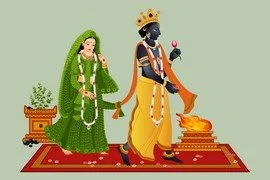
Tulasi Vivah is the ceremonial marriage of the Tulasi plant, revered as Goddess Tulasi, with the Hindu deity Lord Vishnu or His incarnation, Lord Krishna. The Padma Purana mentions Tulasi Vivah as being performed on Kartika Shukla Navami, although other scriptures consider the five days from Prabodhini Ekadashi to Kartika Purnima as especially auspicious for this ritual. Tulasi Vivah is one of the most celebrated festivals in Hinduism. On this day, the marriage of Tulasi as Goddess Vrinda and Shaligram, a sacred stone symbolizing Lord Vishnu is solemnized. In Vrindavan, Mathura and the entire Braj region, Tulasi Vivah is organized in homes and temples in accordance with traditional Hindu wedding rituals. Devotees observe a fullday fast and arrange the wedding ceremony in the evening. In temples dedicated to Krishna, Tulasi Vivah is celebrated with great enthusiasm. A wedding tableau is created featuring Goddess Tulasi and Lord Krishna and grand festivities are held. All customary wedding rituals such as Haldi, Mehendi, Jaimala, Phera and Baraat are observed, just like in a real marriage. In all the ancient Krishna temples of Vrindavan, a Tulasi Ghera or enclosure is considered essential. Without Tulasi leaves, no offering or Bhoga is made to the deity. Therefore, the festival of Tulasi Vivah is celebrated here with exceptional grandeur.
Deities & divine forms
In the Prabhu Dham located in Saunja village of Bihar, the festival of Tulasi Vivah is celebrated collectively by the whole village. In this village, a threeday celebration is observed from Ekadashi to Trayodashi during the Kartika month. On the first day, villagers participate in Vedic recitations and group readings of the Ramcharitmanas or the Ramayana. The second day features a grand procession or ShobhaYatra and the third day is dedicated to the Tilak ceremony and the divine wedding of Lord Vishnu and Goddess Vrinda. On this occasion, the villagers jointly prepare Chhappan Bhoga, a feast of 56 offerings, which is then distributed among devotees as Prasada. In Maharashtra, the Tulasi Vivah ritual involves placing a white cloth, known as Antahpata, between the bride, Goddess Tulasi and the groom, Lord Vishnu. The priest then recites wedding Mantras, including Mangalashtaka. At the end of the chanting, devotees sprinkle Akshata, rice mixed with vermilion on Tulasi and Vishnu. The white cloth is then ceremoniously removed between the deities and all the attendees clap and chant slogans of victory, symbolizing the community's approval of the divine marriage. Just like a real wedding, the entire sequence of marriage rituals is performed. Typically, the expenses of the ceremony are borne by a couple without a daughter or children, who assume the role of Tulasi's parents during the wedding. After the ceremony, all the bridal offerings presented to Tulasi are gifted to a Brahmin priest or a female ascetic. The Prasada distributed usually includes sugarcane, coconut sweets, fruits and peanuts. In two Rama temples in the Saurashtra region, the wedding ceremony is celebrated in a grand manner. An invitation card is sent from the bride's temple to the groom's temple. On the day of Prabodhini Ekadashi, a wedding procession of Lalji, a form of Lord Vishnu, sets off toward the bride Tulasi's temple. Devotees sing Bhajan, perform Kirtan and dance while carrying Lalji in a palanquin. At the border of Tulasi's village, the Baraat is welcomed, and the ceremonial wedding takes place at the temple. Couples desiring children perform Kanya Daan, taking on the role of Tulasi's parents. The night is spent in continuous devotional singing and at dawn, Lalji's Barat returns with Tulasi to His village.
How to celebrate Tulasi Vivah 2026
In Vrindavan, Mathura and the entire Braj region, Tulasi Vivah is organized in homes and temples in accordance with traditional Hindu wedding rituals. Devotees observe a fullday fast and arrange the wedding ceremony in the evening. In temples dedicated to Krishna, Tulasi Vivah is celebrated with great enthusiasm. A wedding tableau is created featuring Goddess Tulasi and Lord Krishna and grand festivities are held. All customary wedding rituals such as Haldi, Mehendi, Jaimala, Phera and Baraat are observed, just like in a real marriage. In all the ancient Krishna temples of Vrindavan, a Tulasi Ghera or enclosure is considered essential. Without Tulasi leaves, no offering or Bhoga is made to the deity. Therefore, the festival of Tulasi Vivah is celebrated here with exceptional grandeur. In the Prabhu Dham located in Saunja village of Bihar, the festival of Tulasi Vivah is celebrated collectively by the whole village. In this village, a threeday celebration is observed from Ekadashi to Trayodashi during the Kartika month. On the first day, villagers participate in Vedic recitations and group readings of the Ramcharitmanas or the Ramayana. The second day features a grand procession or ShobhaYatra and the third day is dedicated to the Tilak ceremony and the divine wedding of Lord Vishnu and Goddess Vrinda. On this occasion, the villagers jointly prepare Chhappan Bhoga, a feast of 56 offerings, which is then distributed among devotees as Prasada.
Tulasi Vivah 2026 — FAQs
Tulasi Vivah for Diu, Daman and Diu, India is observed on 2026-11-21.
Tulasi Vivah is the ceremonial marriage of the Tulasi plant, revered as Goddess Tulasi, with the Hindu deity Lord Vishnu or His incarnation, Lord Krishna. The Padma Purana mentions Tulasi Vivah as being performed on Kartika Shukla Navami, although other scriptures consider the five days from Prabodhini Ekadashi to Kartika Purnima as especially auspicious for this ritual. Tulasi Vivah is one of the most celebrated festivals in Hinduism. On this day, the marriage of Tulasi as Goddess Vrinda and Shaligram, a sacred stone symbolizing Lord Vishnu is solemnized.