About Maha Ashtami
Last updated:
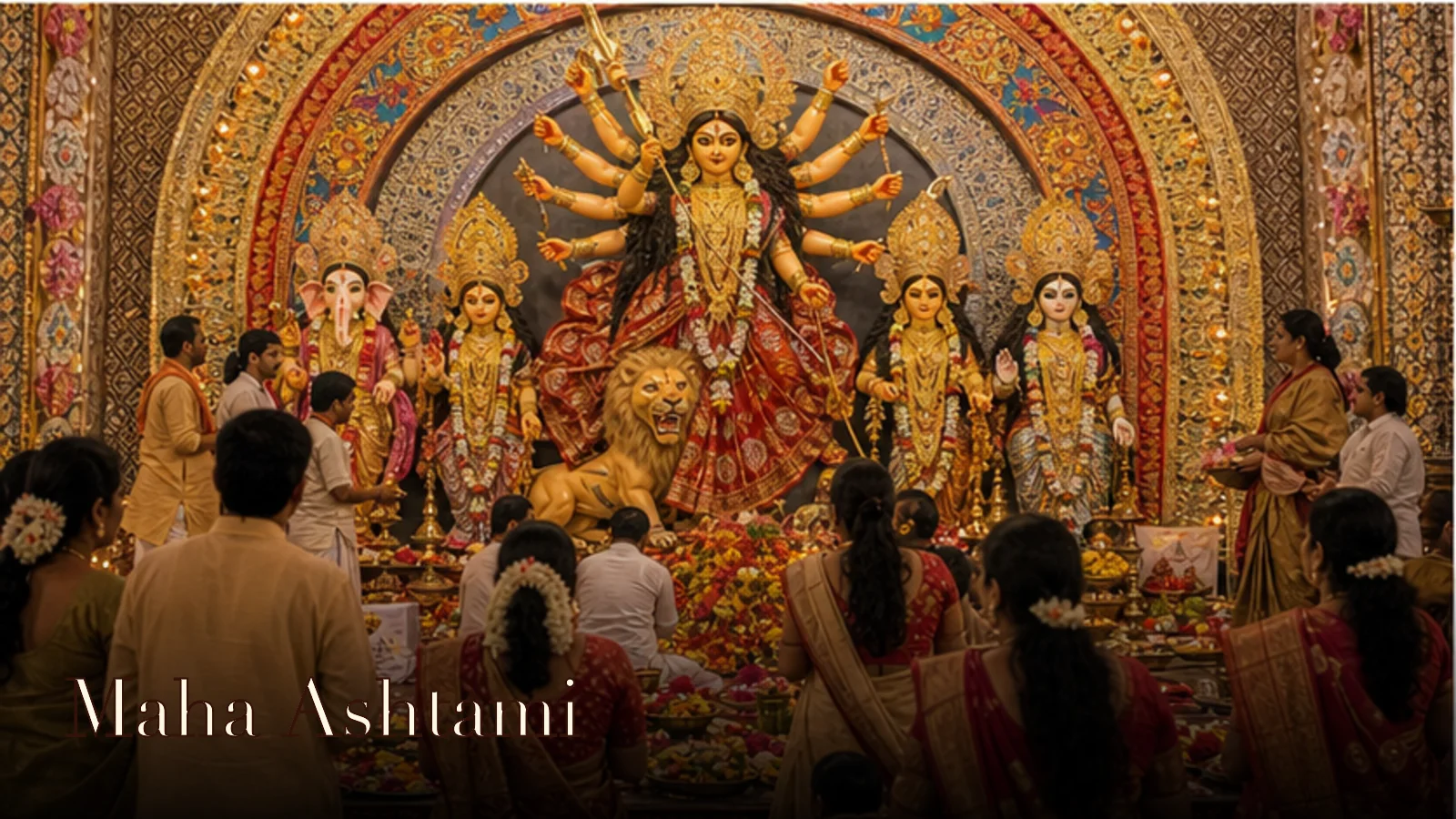
Maha Ashtami, the eighth day of Shukla Paksha during Ashwin month, is widely regarded as the most potent and sacred night of the entire Navratri festival. While all nine nights of Navratri carry great spiritual energy, Ashtami is believed to be the night when Goddess Durga is most fully present in her fierce, warrior aspect — the night she vanquished Mahishasura and the cosmic forces of darkness were finally overcome by divine feminine power.
The day reaches its absolute spiritual peak with the Sandhi Puja — a uniquely timed ritual performed at the precise junction (sandhi) between Ashtami and Navami tithis. This 48-minute window (24 minutes before and 24 minutes after the transition) is considered the most auspicious moment of the entire Navratri cycle. According to scripture, it was during this exact transition that Goddess Chamunda appeared and slew the demons Chanda and Munda. During Sandhi Puja, 108 diyas are lit, 108 lotus flowers are offered, and the Devi is worshipped with intense devotion. In Bengal, this is the most elaborate and emotionally charged puja of the entire Durga Puja festival.
Maha Ashtami is also marked by Kanya Puja, in which nine young girls (between the ages of 2 and 10) are worshipped as the nine forms of Navadurga. Their feet are washed, they are adorned with red clothing and flowers, offered a full meal (puri, chana, halwa), and given gifts. This beautiful ritual embodies the Shakta teaching that the divine feminine is present in every woman and girl. In some traditional communities and Durga temples, particularly in Bengal, Odisha, and parts of North India, animal sacrifice (bali) is also performed on Maha Ashtami as an offering to the Goddess in her fierce form.
Significance of Maha Ashtami
Maha Ashtami holds layered significance across multiple dimensions of Hindu tradition:
- Cosmic Battle Culmination: The eighth day marks the critical turning point in the battle between Goddess Durga and the buffalo demon Mahishasura — the night the tide of cosmic war shifted decisively toward dharma.
- Chamunda's Appearance: It is on the Ashtami-Navami sandhi that Goddess Chamunda (the most terrifying form of Devi) manifested to destroy the demons Chanda and Munda, making this junction the most powerful moment of Navratri.
- Sandhi Puja Power: The 48-minute transition window carries concentrated spiritual energy that scriptures say is equivalent to the cumulative merit of all nine days of Navratri puja combined.
- Kanya Puja — Devi in Every Girl: The worship of nine young girls as Navadurga on Ashtami is a living embodiment of the Shakta philosophy that divinity dwells in the feminine form — young, pure, uncontaminated by ego.
- 108 as Sacred Number: The 108 diyas and 108 lotus flowers offered during Sandhi Puja correspond to the 108 names of Devi, the 108 Upanishads, and the sacred geometry of spiritual completeness.
- Festival of Shakti Awakening: Navratri as a whole, and Ashtami in particular, represents the awakening of the divine feminine (Shakti) within the devotee — the night the inner demon of ego is slain.
- Regional Diversity: From elaborate Durga Puja in Bengal to the sword worship (Ayudha Puja) and Kolu displays in South India, Maha Ashtami reveals the extraordinary breadth of India's living Goddess traditions.
Deities worshipped on Maha Ashtami
Follow the links to explore each deity’s mantras, stories, and temples on Temples.bio.
Goddess Durga
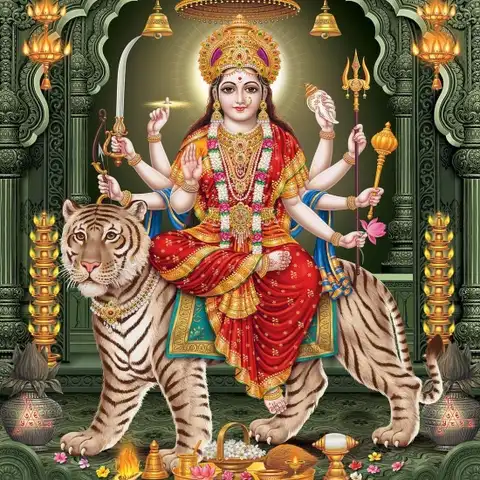
Principal deity of Navratri and Maha Ashtami — worshipped in her eighth form as Mahagauri and fierce form as Chamunda during Sandhi Puja
The Invincible Mother Goddess — Supreme Feminine Power who destroys evil, protects the righteous, and embodies the divine energy of the entire universe.
View deity →
Goddess Saraswati
Worshipped on Maha Ashtami in South India during Saraswati Puja — books and instruments placed at her feet for blessing
The Invincible Mother Goddess — Supreme Feminine Power who destroys evil, protects the righteous, and embodies the divine energy of the entire universe.
View deity →Maha Ashtami is dedicated primarily to Goddess Mahagauri (the eighth form of Navadurga) and Goddess Chamunda. Mahagauri embodies purity, peace, and the fulfillment of all desires — she is depicted in white, riding a white bull, representing the state of Devi after her intense tapas purified her. On the deeper, esoteric level, Ashtami also invokes Goddess Kali and Chamunda — the dark, fierce, skull-garlanded manifestations of Durga who destroy the most stubborn inner and outer enemies. The Sandhi Puja is specifically dedicated to Goddess Chamunda, who appeared at the exact Ashtami-Navami junction. In Bengal, the principal deity of the entire Durga Puja is worshipped on Maha Ashtami in a grand Pushpanjali ceremony where thousands of devotees offer flowers chanting the Devi Stuti in unison. Goddess Saraswati is also worshipped on Ashtami in South India (Saraswati Puja), where books, musical instruments, and tools are placed before the Goddess for her blessing.
How to celebrate Maha Ashtami 2026
1. Wake before sunrise and complete your bath — Ashtami puja should begin in a state of ritual purity.
2. Set up the puja space: Establish the Kalash (sacred pot with mango leaves and coconut) if not already done from day one of Navratri. Place the image or idol of Goddess Durga/Mahagauri at the centre.
3. Perform the main Durga Puja: Offer red flowers (especially hibiscus), red kumkum, turmeric, sindoor, coconut, fruits, and sweets. Light ghee diyas and incense.
4. Recite the Durga Saptashati (Chandi Path): Chapter 8 (on the killing of Chanda and Munda) is especially significant on Maha Ashtami.
5. Prepare for Sandhi Puja: Identify the exact time of Ashtami-Navami tithi transition (published in Panchang). Begin puja 24 minutes before.
6. Sandhi Puja ritual: Light 108 diyas, offer 108 lotus flowers (or red hibiscus), recite the Sandhi Puja shloka, perform Devi aarti with all instruments — this is the peak moment.
7. Kanya Puja: Invite nine young girls (ages 2–10). Wash their feet with milk and water. Apply alta (red dye) to their feet. Offer them red dupatta, flowers, and a full meal of puri, kala chana, and suji halwa. Give dakshina (gifts or money) before they leave.
8. Perform Havan (fire sacrifice) if conducting a formal puja — oblations of sesame, ghee, and havan samagri into sacred fire.
9. Fast throughout the day, breaking only after the evening aarti or after Kanya Puja.
10. If visiting a Durga temple, arrive early for Sandhi Puja darshan as crowds are at their peak.
Rituals & regional traditions
- Sandhi Puja: The defining ritual of Maha Ashtami — 108 diyas lit and 108 lotus flowers offered at the precise 48-minute Ashtami-Navami junction, accompanied by beating of drums and blowing of conch shells
- Kanya Puja (Kumari Puja): Nine girls worshipped as the nine forms of Navadurga — feet washed, adorned with red cloth, offered puri-chana-halwa meal, and given gifts
- Pushpanjali in Bengal: Mass flower offering ceremony at the pandal where thousands chant Devi stotras in unison on Maha Ashtami morning
- Durga Saptashati Recitation: The eighth chapter (Devi slaying Chanda-Munda) is specifically recited on Ashtami for its correspondence to this tithi
- Havan and Yagna: Fire sacrifice performed in Akhanda (continuous) manner by priests, with 108 ahutis (oblations) in the sacred fire
- Ayudha Puja (South India): Weapons, tools, vehicles, and books are ritually worshipped on Ashtami in Karnataka, Tamil Nadu, and Andhra Pradesh
- Bali (Animal Offering): In traditional Shakta communities and certain Durga temples in Bengal, Odisha, and Nepal, animal sacrifice is performed on Maha Ashtami
- Overnight Jagran: Many devotees observe an all-night vigil (jagran) singing devotional songs to Devi through the Ashtami night
Spiritual benefits
- Performing Sandhi Puja on Maha Ashtami is said to bestow the accumulated merit of all nine days of Navratri in a single 48-minute window
- Kanya Puja is believed to earn the blessings of all nine forms of Navadurga simultaneously, fulfilling wishes and removing obstacles
- Maha Ashtami fasting and puja is said to grant protection from enemies, disease, and the evil eye throughout the year
- Offering 108 red hibiscus flowers to Devi on Ashtami is believed to bestow prosperity, beauty, and marital happiness
- Reciting Durga Saptashati on Maha Ashtami is said to destroy the most stubborn negative forces in one's life
- Devotion on Maha Ashtami is believed to awaken the Shakti (divine energy) within the devotee, leading to inner transformation
- Visiting a major Durga temple on Maha Ashtami and attending the Sandhi Puja darshan is said to confer liberation from fear in all its forms
- Observing Ashtami vrat with sincerity is said to ensure the protection and long life of one's children
Mantras & sacred chants
YA DEVI SARVABHUTESHU SHAKTI RUPENA SAMSTHITA, NAMASTASYAI NAMASTASYAI NAMASTASYAI NAMO NAMAH
Sanskrit: या देवी सर्वभूतेषु शक्तिरूपेण संस्थिता। नमस्तस्यै नमस्तस्यै नमस्तस्यै नमो नमः॥
Meaning: Salutations to the Goddess who dwells in all beings as Shakti (power). Salutations, salutations, salutations to her — the central shloka of the Durga Saptashati, chanted throughout Navratri but especially potent on Maha Ashtami.
OM AIM HREEM KLEEM CHAMUNDAYAI VICHCHE
Sanskrit: ॐ ऐं ह्रीं क्लीं चामुण्डायै विच्चे
Meaning: The bija (seed) mantra of Goddess Chamunda — Aim is Saraswati's bija, Hreem is Maya's bija, Kleem is attraction bija. This is the primary Sandhi Puja mantra, invoking the fierce Chamunda who manifested at this exact juncture.
SARVAMANGALA MAANGALYE SHIVE SARVARTHA SADHIKE, SHARANYE TRYAMBAKE GAURI NARAYANI NAMOSTUTE
Sanskrit: सर्वमङ्गल माङ्गल्ये शिवे सर्वार्थसाधिके। शरण्ये त्र्यम्बके गौरि नारायणि नमोऽस्तुते॥
Meaning: O auspicious one who bestows all auspiciousness, O Shiva, O Accomplisher of all goals, O refuge, O three-eyed Gauri, O Narayani — salutations to you. This Devi stotra is chanted during the Kanya Puja and at the conclusion of the main Ashtami puja.
Maha Ashtami 2026 — FAQs
Maha Ashtami 2026 falls on October 20, 2026. It is the eighth day of Ashwin Shukla Paksha Navratri, dedicated to Goddess Mahagauri and Chamunda.
Sandhi Puja is the most sacred ritual of Navratri, performed at the exact junction (sandhi) between Ashtami and Navami tithis. It lasts 48 minutes (24 min before and 24 min after the transition), during which 108 diyas are lit and 108 lotus flowers are offered to Goddess Chamunda.
Kanya Puja (also called Kumari Puja) involves worshipping nine young girls between ages 2 and 10 as the nine forms of Navadurga. Their feet are washed, they are given red clothing, and offered puri, kala chana, and halwa before receiving gifts and dakshina.
Maha Ashtami is primarily dedicated to Goddess Mahagauri (the eighth Navadurga) and Goddess Chamunda. The Sandhi Puja at the Ashtami-Navami junction is specifically for Chamunda, who appeared at that moment to slay the demons Chanda and Munda.
Maha Ashtami (eighth day) features the Sandhi Puja at the Ashtami-Navami junction and Kanya Puja. Maha Navami (ninth day) focuses on the completion of the Navadurga cycle, Havan and Yagna, and is the final day before Vijayadashami (Dussehra).
Wake before sunrise, bathe, set up the Durga idol with Kalash. Offer red flowers, kumkum, coconut, and sweets. Recite Durga Saptashati Chapter 8. Perform Sandhi Puja at the exact transition time with 108 diyas. Do Kanya Puja by inviting 9 young girls for worship and feeding. Fast throughout the day.
108 is a sacred number in Hinduism corresponding to the 108 names of the Goddess, the 108 Upanishads, and sacred geometric completeness. Lighting 108 diyas during Sandhi Puja represents offering light to all 108 aspects of Devi simultaneously.
Yes — in Bengal, Maha Ashtami is the grandest day of Durga Puja. It features the mass Pushpanjali (flower offering ceremony), elaborate Sandhi Puja with drums and conches, and Kumari Puja where young girls are worshipped as the Goddess. The atmosphere in Bengal on Maha Ashtami is unparalleled in its fervour.