About Maha Navami and during Navratri
Last updated:
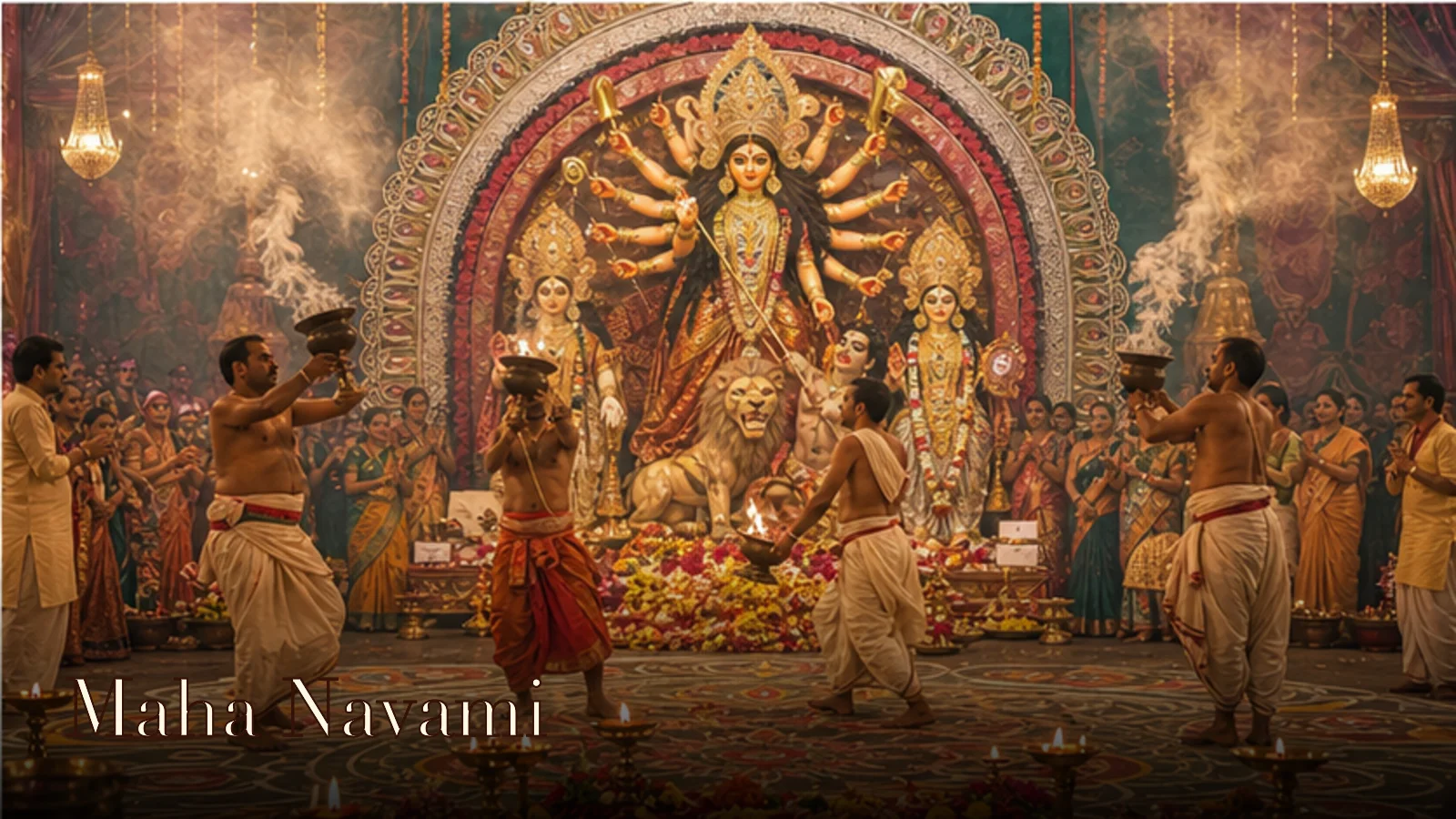
Mahanavami is third and final day of Durga Puja. Durga Puja on Maha Navami begins with Mahasnan and Shodashopachar Puja. On Maha Navami Goddess Durga is worshipped as Mahisasuramardini which means the Annihilator of the Buffalo Demon. It is believed that on Maha Navami day Durga killed the demon Mahishasura. It is important to note that depending on starting of Navami Tithi on previous day Maha Navami Puja and Upavas might be done on Ashtami Tithi. The precise rule is that if Ashtami and Navami merge before Sanyakal on Ashtami Tithi then Ashtami Puja and Navami Puja including Sandhi Puja are done on the same day.
Deities worshipped on Maha Navami and during Navratri
Follow the links to explore each deity’s mantras, stories, and temples on Temples.bio.
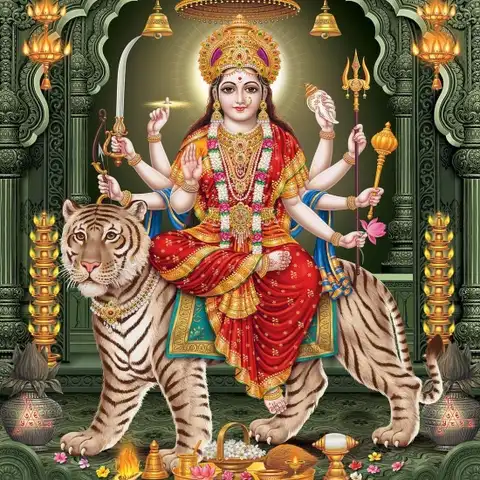
Goddess Durga
Primary deity — Siddhidatri form worshipped on Navami
The Invincible Mother Goddess — Supreme Feminine Power who destroys evil, protects the righteous, and embodies the divine energy of the entire universe.
View deity →
Goddess Saraswati
Worshipped on Navami in South India and Bengal for knowledge blessings
The Invincible Mother Goddess — Supreme Feminine Power who destroys evil, protects the righteous, and embodies the divine energy of the entire universe.
View deity →Maha Navami centers on Goddess Durga — the supreme mother goddess, warrior deity, and cosmic protector who embodies the collected power of all gods. In her Navami manifestation, she is specifically worshipped as Siddhidatri (bestower of supernatural accomplishments) and as Mahishasuramardini (destroyer of the buffalo demon). Durga is the primordial Shakti, born from the combined divine energies of Brahma, Vishnu, and Shiva to destroy what the gods could not.
In South India, particularly Karnataka and Tamil Nadu, the presiding deity is Chamundeshwari — a fierce form of Durga who slew the demons Chanda and Munda and ultimately Mahishasura. The Mysore Dasara festival, one of India's grandest, culminates on Maha Navami with the famous torchlight parade. Goddess Saraswati is also prominently worshipped on this day in South India and Bengal, as the day before Vijayadashami is dedicated to placing books and instruments before her. The young girls worshipped in Kanya Puja are revered as direct embodiments of the nine forms of Durga herself.
How to celebrate Maha Navami and during Navratri 2026
On Maha Navami Goddess Durga is worshipped as Mahisasuramardini which means the Annihilator of the Buffalo Demon. It is believed that on Maha Navami day Durga killed the demon Mahishasura. It is important to note that depending on starting of Navami Tithi on previous day Maha Navami Puja and Upavas might be done on Ashtami Tithi. The precise rule is that if Ashtami and Navami merge before Sanyakal on Ashtami Tithi then Ashtami Puja and Navami Puja including Sandhi Puja are done on the same day. However Durga Balidan is always done on Uday Vyapini Navami Tithi. According to Nirnaysindhu the most appropriate to perform Balidan on Navami is Aparahna Kaal.
Spiritual benefits
- Complete fulfillment of desires and boons (siddhis) as the ninth day is ruled by Siddhidatri, the goddess of supernatural accomplishments.
- Protection from enemies, evil forces, and negative energies as Durga's fierce energy reaches its maximum on Navami.
- Excellence in one's profession and livelihood through the blessing of Ayudha Puja, which sanctifies the tools of one's work.
- Academic success and knowledge enhancement through Saraswati Puja performed on this day, especially for students.
- Purification of the nine energy centers (chakras) through nine days of Navratri culminating in the Navami observance.
- Blessings of motherhood, marital harmony, and protection for children — especially sought through Kanya Puja.
- Freedom from the nine types of obstacles (nava vignas) that block spiritual and material progress.
- Accumulation of the combined merit of all nine days of Navratri through the final and most powerful day's observance.
Mantras & sacred chants
Durga Navami Mantra:
Sanskrit: ॐ ऐं ह्रीं क्लीं चामुण्डायै विच्चे (Om Aim Hreem Kleem Chamundayai Vicche)
Meaning: This powerful Navarna (nine-syllable) mantra invokes Chamunda — the fierce form of Durga who destroyed the demons. "Aim" invokes Saraswati's wisdom, "Hreem" invokes Mahalakshmi's power, "Kleem" invokes Mahakali's strength. Chanting 108 times on Navami yields immense spiritual merit.
Siddhidatri Mantra:
Sanskrit: ॐ देवी सिद्धिदात्र्यै नमः (Om Devi Siddhidatryai Namah)
Meaning: "I bow to Goddess Siddhidatri, the bestower of all supernatural powers and perfections." Chanted on Navami specifically to invoke the ninth form of Durga who grants all eight supernatural accomplishments (ashta siddhis).
Durga Saptashati Navami Shloka:
Sanskrit: या देवी सर्वभूतेषु शक्तिरूपेण संस्थिता। नमस्तस्यै नमस्तस्यै नमस्तस्यै नमो नमः॥
(Ya Devi Sarvabhuteshu Shaktiroopena Samsthita, Namastasyai Namastasyai Namastasyai Namo Namah)
Meaning: "Salutations again and again to that Goddess who is present in all beings as the power of Shakti." This universal verse from Devi Mahatmyam is the most recited shloka of Navratri.
Maha Navami and during Navratri 2026 — FAQs
Maha Navami 2026 falls on Wednesday, October 21, 2026. It is the ninth day of Sharad Navratri observed on Ashwin Shukla Navami in the Hindu calendar.
Maha Navami puja includes waking before sunrise, reciting Durga Saptashati, performing Shodashopachar puja to the Goddess, conducting Kanya Puja (worshipping nine young girls), Ayudha Puja (worshipping tools and instruments), performing a havan, and keeping a night-long jagran vigil.
Kanya Puja is the ritual of worshipping nine young girls (aged 2-10) as living embodiments of the nine forms of Goddess Durga. Their feet are washed, tilak is applied, they are served a special meal of halwa, puri, and chana, and given gifts of clothing and money (dakshina).
Ayudha Puja is the South Indian tradition of worshipping tools, weapons, vehicles, books, and musical instruments on Maha Navami. All implements of one's profession are cleaned, decorated, and offered flowers and vermilion, acknowledging divine Shakti in the instruments of livelihood.
On Maha Navami, Goddess Durga is worshipped in her ninth form as Siddhidatri — the bestower of all supernatural powers. In South India, she is worshipped as Chamundeshwari. The day also marks Saraswati Puja in South India and Bengal.
Maha Navami is the ninth day of Navratri marking the final night of Durga's battle with Mahishasura and the peak of worship. Vijayadashami (Dussehra) is the tenth day celebrating her victory. Navami is the night of vigil and preparation; Vijayadashami is the day of triumph and new beginnings.
The Mysore Dasara Maha Navami is world-famous, featuring a grand royal durbar at the Mysore Palace, a procession of caparisoned elephants, cultural performances, and the spectacular Torch Light Parade by the armed forces — all watched by hundreds of thousands of visitors.
Devotees observe a complete fast (nirjala or phalahar) on Maha Navami, consuming only fruits, milk, and water or nothing at all until the evening aarti and Kanya Puja are completed. The fast is broken after worshipping the young girls and receiving their blessings.