About Mysuru Dasara
Last updated:
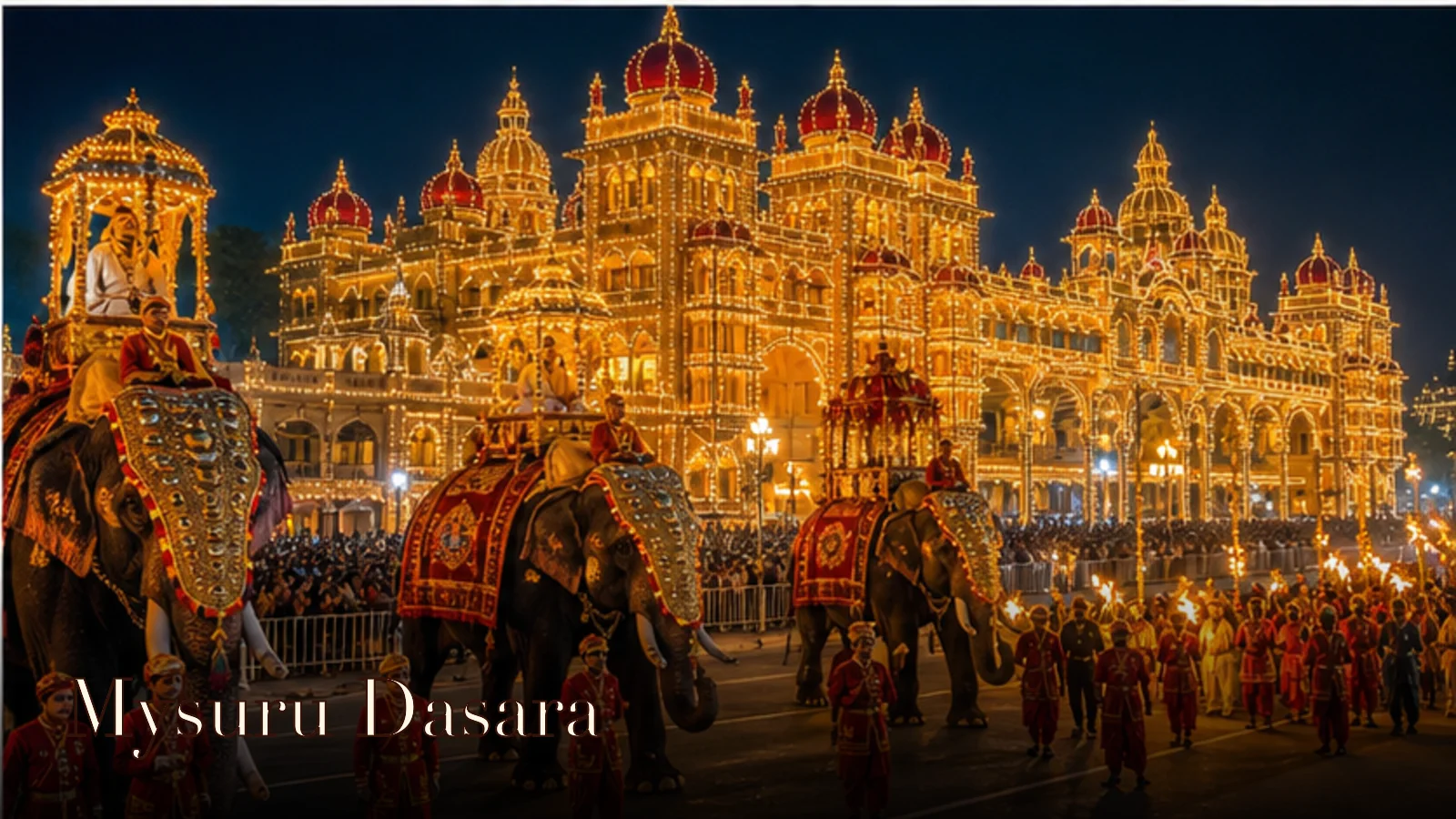
Mysuru Dasara, also spelled Mysore Dasara, is one of 's most spectacular state festivals, celebrated with extraordinary pomp and pageantry in the city of Mysuru, Karnataka. Declared the Nadahabba (state festival) of Karnataka, this 10-day celebration culminates on Vijayadashami, the tenth day of the bright fortnight of the Ashwin month. The festival has been celebrated continuously for over four centuries, tracing its roots to the Vijayanagara Empire and carried forward with grandeur by the Wadiyar dynasty of Mysore. At the heart of Mysuru Dasara is the worship of Chamundeshwari Devi, a fierce form of Goddess Durga who resides atop the Chamundi Hills overlooking Mysuru. The royal family performs special puja at the Chamundeshwari Temple each day of the festival. The Mysore Palace, one of 's most visited monuments, is illuminated with nearly 100,000 light bulbs every evening, transforming it into a luminous jewel visible from miles away. Cultural programs, exhibitions, sporting events, and Dasara processions fill the ten days with color and festivity. The climax of Mysuru Dasara is the Jamboo Savari, the grand royal procession held on Vijayadashami day. The golden idol of Chamundeshwari Devi is placed in a golden howdah weighing approximately 750 kilograms and carried by the lead elephant, flanked by caparisoned elephants, cavalry, decorated tableaux, folk artists, and marching bands. The procession traverses the royal route through the city, witnessed by hundreds of thousands of devotees and tourists from across the world, making it one of Asia's grandest cultural parades.
Significance of Mysuru Dasara
Mysuru Dasara holds profound spiritual, cultural, and historical significance at large. - Spiritual Victory: The festival commemorates the victory of Goddess Chamundeshwari over the demon Mahishasura, symbolizing the eternal triumph of good over evil, light over darkness, and dharma over adharma. - Royal Tradition: The Wadiyar kings of Mysore institutionalized Dasara as a state ceremony blending royal power with divine blessing, a tradition spanning over 400 years that continues under the present Mysore royal family. - Cultural Heritage: Mysuru Dasara is recognized as one of 's Intangible Cultural Heritages, preserving ancient Dravidian and Vijayanagara-era traditions of royal worship, procession arts, and folk performances. - Cosmic Alignment: Celebrated at the junction of Sharad Navaratri and Vijayadashami, it aligns with the cosmic shift when Goddess Durga completes her nine-night battle and emerges victorious, making it an auspicious time for new beginnings. - Community Bonding: The festival transcends caste and community lines in Karnataka, bringing together millions of people in shared celebration, reinforcing social cohesion and cultural pride. - Chamundi Hills Shakti Peetha: The Chamundeshwari Temple atop Chamundi Hills is revered as one of the 18 Maha Shakti Peethas, lending immense religious weight to the entire festival. - National Tourism: Mysuru Dasara draws over a million visitors annually, showcasing Karnataka's rich heritage to the nation and the world.
Deities worshipped on Mysuru Dasara
Follow the links to explore each deity’s mantras, stories, and temples on Temples.bio.
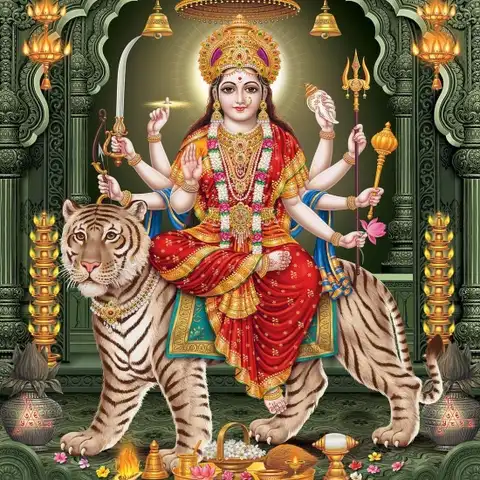
The central deity of Mysuru Dasara is Chamundeshwari Devi, the presiding goddess of Mysuru and a fierce manifestation of Goddess Durga. According to legend, the demon Mahishasura terrorized the heavens and earth with his shape-shifting powers until the gods collectively invoked the energy of all deities to create the supreme Goddess. She engaged Mahishasura in a fierce battle on the hills now known as Chamundi Hills and slew him on the tenth day, Vijayadashami. The hill and city derive their names from this legend — Chamundi slew Mahisha, hence Chamundi Hills, and Mahishasura's name is said to be echoed in Mysuru.
Chamundeshwari Devi is depicted as an eight-armed goddess seated on a lion, holding weapons including a trident, sword, and chakra, representing her omnipotent power to vanquish evil. The golden idol used in the Jamboo Savari procession is a specially crafted image of the goddess in full regalia. Additionally, Lord Ganesha is propitiated at the start of all ceremonies as the remover of obstacles, and the nine forms of Durga (Navadurga) are worshipped through the nine nights of Navaratri preceding Vijayadashami.
How to celebrate Mysuru Dasara 2026
How to Observe Mysuru Dasara:
1. Visit Chamundeshwari Temple atop Chamundi Hills during the 10-day festival period for special darshan and puja.
2. Observe Navaratri fasting and Golu (display of dolls and figurines) in your home for nine days, invoking the nine forms of Durga.
3. On Vijayadashami morning, perform Ayudha Puja — worship your tools, vehicles, books, and instruments as manifestations of divine energy.
4. Attend or watch the Jamboo Savari procession on Vijayadashami day, which proceeds from the Mysore Palace to Bannimantapa grounds.
5. Visit the Mysore Palace in the evenings during the 10 days to witness the spectacular illumination with 100,000 light bulbs.
6. Participate in Torchlight Parade held in the evenings near Bannimantapa after the Jamboo Savari.
7. Attend cultural programs, classical dance and music performances organized at various venues across Mysuru.
8. On Vijayadashami, begin new ventures, enroll children in education (Vidyarambha), or start learning a new skill as the day is considered supremely auspicious.
9. Offer prayers at Banni tree (Shami tree) on Vijayadashami evening as tradition holds this symbolizes the retrieval of weapons by the Pandavas.
Rituals & regional traditions
- Jamboo Savari: The grand elephant procession carrying the golden idol of Chamundeshwari on Vijayadashami is the defining ritual, drawing millions of spectators.
- Palace Illumination: The Mysore Palace and surrounding buildings are lit with nearly 100,000 bulbs every evening from 7 PM to 10 PM throughout the festival.
- Navaratri Puja: Nine days of Navaratri puja with Golu (Kolu) display of dolls arranged on steps, common in Karnataka and Tamil households.
- Ayudha Puja: On Navami (ninth day), tools, vehicles, musical instruments, and books are worshipped — garages, factories, and schools participate widely.
- Vidyarambha: Children are initiated into learning on Vijayadashami with the Vidyarambha ceremony, writing their first letters in rice or sand.
- Torchlight Parade: Military and police bands perform an evening torchlight parade on Vijayadashami night at Bannimantapa.
- Private Durbar: The Mysore royal family holds a private Durbar (court) on Vijayadashami in the traditional style of the Wadiyar kings.
- Cultural Exhibitions: Dasara exhibitions, trade fairs, and karaga (folk fire ritual) performances take place across Mysuru city.
- Banni Tree Worship: Shami (Banni) tree puja on Vijayadashami evening is observed by families across Karnataka.
Spiritual benefits
- Protection from evil: Worshipping Chamundeshwari Devi invokes her power to destroy negative forces and evil influences in one's life.
- Victory and success: Vijayadashami is the day of Vijaya (victory); beginning new ventures on this day is believed to guarantee success.
- Purification: The nine-day Navaratri fast and puja purify the mind and body, removing accumulated negative karma.
- Academic blessings: Vidyarambha on Vijayadashami blesses children with intelligence, memory, and lifelong love of learning.
- Courage and strength: Devotion to Chamundeshwari grants fearlessness and inner strength to face life's challenges.
- Cultural rootedness: Participation in this heritage festival deepens one's connection to Karnataka's history and community identity.
- Divine grace: The festival period is considered extremely auspicious for prayers, and the goddess is said to be especially accessible to devotees during Navaratri and Dasara.
Mantras & sacred chants
Mantra 1 — Chamundeshwari Moola Mantra:
Sanskrit: ॐ ऐं ह्रीं क्लीं चामुण्डायै विच्चे
Transliteration: Om Aim Hrim Klim Chamundayai Vicche
Meaning: Salutations to Goddess Chamunda — this bija mantra invokes her three primal energies of wisdom (Aim), power (Hrim), and desire-fulfillment (Klim) to destroy all evil.
Mantra 2 — Durga Saptashati Victory Shloka:
Sanskrit: या देवी सर्वभूतेषु शक्तिरूपेण संस्थिता। नमस्तस्यै नमस्तस्यै नमस्तस्यै नमो नमः।।
Transliteration: Ya Devi Sarvabhuteshu Shakti-rupena Samsthita, Namastasyai Namastasyai Namastasyai Namo Namah
Meaning: Salutations to the Goddess who abides in all beings as pure energy — we bow to her, bow to her, bow to her again and again.
Mantra 3 — Vijayadashami Sankalpa:
Sanskrit: ॐ अपराजितायै नमः
Transliteration: Om Aparajitayai Namah
Meaning: Salutation to the unconquerable Goddess — chanted on Vijayadashami to invoke the energy of the goddess who cannot be defeated.
Mysuru Dasara 2026 — FAQs
Mysuru Dasara 2026 falls on October 22, which is Vijayadashami (Ashwin Shukla Dashami). The 10-day celebrations begin on October 13, 2026 with the start of Navaratri.
Jamboo Savari is the grand elephant procession held on Vijayadashami in Mysuru. The golden idol of Chamundeshwari Devi is placed in a 750 kg golden howdah carried by the lead elephant, accompanied by caparisoned elephants, cavalry, folk artists, and tableaux.
Chamundeshwari Devi, a fierce form of Goddess Durga residing atop Chamundi Hills in Mysuru, is the presiding deity of Mysuru Dasara. She is worshipped for slaying the demon Mahishasura on Vijayadashami.
Ayudha Puja, observed on the ninth day (Navami) of Navaratri, involves worshipping tools, vehicles, musical instruments, and books as manifestations of divine energy. It is widely observed across Karnataka and Tamil Nadu.
The Mysore Palace is illuminated with approximately 100,000 (one lakh) light bulbs every evening from 7 PM to 10 PM throughout the 10-day Dasara festival, creating a breathtaking spectacle visible from miles around.
Vidyarambha is the auspicious ceremony of initiating children into formal education on Vijayadashami. Children write their first letters in a tray of rice or sand, and the day is considered ideal for starting any new learning.
While Mysuru is the epicenter of the grandest celebrations, Dasara (Vijayadashami) is celebrated across Karnataka and all of India. The Mysuru celebrations are unique for their royal heritage, elephant procession, and palace illumination.
Mysuru Dasara has been celebrated for over 400 years, originating with the Vijayanagara Empire and continued by the Wadiyar dynasty. It was declared Karnataka's state festival (Nadahabba) and is recognized as one of India's Intangible Cultural Heritages.