Hindu Deity
Lord Vishnu
The Preserver of the Universe — the all-pervading Supreme Being who descends to Earth in divine avatars whenever righteousness declines and evil rises.
"Om Namo Narayanaya — I bow to Lord Narayana, the refuge of all beings, the sustainer of the entire cosmos."
Overview
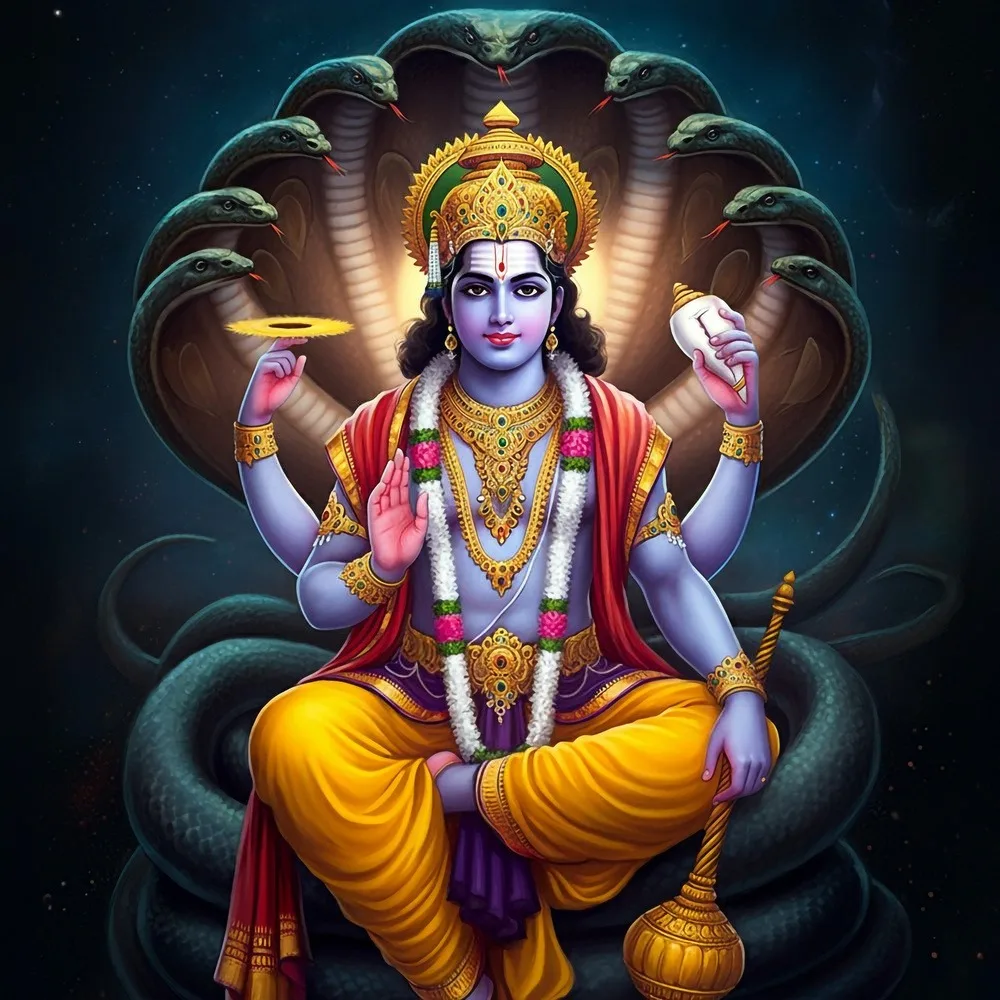
Lord Vishnu is the Preserver and Protector of the universe — one of the three principal deities of the Hindu Trinity (Trimurti) alongside Brahma (the Creator) and Shiva (the Destroyer). He is the supreme deity of the Vaishnava tradition, which is the largest denomination within Hinduism. Vishnu is described as the all-pervading cosmic consciousness — the word Vishnu itself derives from the Sanskrit root vis meaning to pervade — he who fills every atom of creation. He reclines in eternal yogic sleep on the cosmic serpent Adi Shesha, floating on the primordial ocean of milk (Ksheera Sagara), from whose navel a lotus emerges containing Brahma who creates each new universe. Vishnu is the source of all avatars — divine incarnations who descend to Earth whenever adharma (unrighteousness) threatens to overwhelm dharma. The Dashavatara — his ten principal avatars — includes Matsya (fish), Kurma (tortoise), Varaha (boar), Narasimha (man-lion), Vamana (dwarf), Parashurama, Rama, Krishna, Buddha, and Kalki (yet to come). He carries four divine attributes — the Shankha (conch shell), Sudarshana Chakra (spinning discus), Kaumodaki (mace), and Padma (lotus) — each held in one of his four hands, each symbolising a fundamental cosmic principle. Vishnu is Narayana — the abode and refuge of all beings — and his consort is Goddess Lakshmi, who is inseparable from him as wealth and grace are inseparable from preservation.
Origin & History
Vishnu is described in the Vedas as a solar deity — one whose three strides encompassed the entire universe (the Trivikrama legend). He appears in the Rig Veda but becomes the supreme deity of preservation in the Puranas — particularly the Vishnu Purana, Bhagavata Purana, and the two great epics, the Ramayana and Mahabharata. He is Svayambhu — self-existent — without birth or death, the eternal substratum of all existence. The Vishnu Sahasranama — the thousand names of Vishnu from the Mahabharata — is one of the most sacred and comprehensive devotional texts in all of Hinduism. Vishnu s consort is Lakshmi — the goddess of wealth and grace — who is as eternal and inseparable from him as light from the sun. She resides on his chest at the mark called Shrivatsa. Vishnu s vehicle (vahana) is Garuda — the divine eagle king — the swiftest and most powerful of all birds, who is himself an object of worship as Vishnu s devoted servant. Vishnu s abode is Vaikuntha — a transcendental realm beyond the material universe where liberated souls reside in eternal bliss in his presence. The great Vaishnava acharyas — Ramanuja, Madhva, and Vallabha — each established profound philosophical systems centred on Vishnu and Narayana as the Supreme Reality. His protection is unconditional — the Bhagavata Purana states that those who surrender to Vishnu are never abandoned, in this life or any other, and the Mahabharata records his own promise: I carry what my devotees lack and I preserve what they have.
Legends & Famous Stories
Samudra Manthan — Churning of the Ocean
When the gods lost their strength due to a curse, Vishnu advised them to churn the cosmic ocean of milk (Ksheera Sagara) with the help of the demons. During the churning, deadly poison (Halahala) emerged first — Shiva drank it. Then emerged Dhanvantari (divine physician), Lakshmi, Kamadhenu, and finally Amrita (nectar of immortality). When the demons seized the Amrita, Vishnu took the form of Mohini — an enchanting woman — and skillfully retrieved it for the gods. This legend shows Vishnu s characteristic method: not brute force but divine intelligence and strategy.
Trivikrama — Three Strides Across the Universe
The demon king Bali had conquered all three worlds through his extraordinary virtue and generosity. Vishnu took the form of Vamana — a small Brahmin dwarf — and approached Bali asking for just three steps of land. Bali, true to his generous nature, agreed. Vamana then grew to cosmic proportions — with his first step covering all of Earth, his second all of the heavens. There was no space left for the third step. Bali bowed his head, offering it as the third step — a moment of such profound humility that Vishnu granted him sovereignty over the underworld (Patala) and eternal remembrance.
Narasimha Saves Prahlada
The demon king Hiranyakashipu had obtained a boon making him nearly invincible — he could not be killed by man or animal, inside or outside, during day or night, on Earth or in the sky, by any weapon. He forbade the worship of Vishnu and persecuted his own son Prahlada, a devoted Vishnu bhakta. Vishnu emerged from a pillar at dusk in the form of Narasimha (half-man, half-lion) and killed Hiranyakashipu at the threshold — satisfying every condition of the boon while violating none. This legend is the most dramatic demonstration of Vishnu s absolute commitment to protecting his sincere devotees.
Gajendra Moksha — The Elephant s Liberation
Gajendra, the king of elephants, was caught by a mighty crocodile and dragged into a lake. He struggled for a thousand years but could not free himself. Finally, exhausted and unable to help himself by his own strength, he raised his trunk above the water holding a lotus, and called out to Vishnu with complete surrender — Adi Moolam — O Primal Root. Vishnu immediately left Vaikuntha on Garuda and severed the crocodile with his Sudarshana Chakra. This legend is the supreme teaching on surrender (prapatti) — God responds instantly to genuine, egoless surrender.
The Origin of Lakshmi from the Ocean
During the Samudra Manthan, Goddess Lakshmi emerged from the cosmic ocean of milk seated on a lotus, radiant and magnificent. She looked across all of creation to choose her eternal consort and garlanded Vishnu — choosing the Preserver as her home, just as grace and abundance naturally rest in what is sustained and protected. Their union is the cosmic principle that preservation and prosperity are inseparable — wherever there is Vishnu, Lakshmi follows.
Anantashayana — The Cosmic Sleep
Between the dissolution and creation of each universe, Vishnu reclines in a state of yogic sleep (Yoga Nidra) on the cosmic serpent Adi Shesha floating on the primordial waters — a state beyond time, space, and causality. From his navel grows a lotus containing Brahma who will create the next universe. This image — Vishnu in Anantashayana — is the most profound cosmological symbol in Hinduism: the universe rests in God during dissolution, and creation emerges from God at the dawn of each new cosmic cycle.
Worship & Rituals
Tulsi Abhishekam & Puja
Tulsi (holy basil) is the most sacred plant of Vishnu — she is considered his consort in plant form and he is said to be incomplete without her. Daily puja involves offering Tulsi leaves and garlands to Vishnu s idol, performing aarti, and circumambulating the Tulsi plant in the home courtyard. Vishnu will not accept any food offering (prasad) that does not contain Tulsi leaves.
Vishnu Sahasranama Recitation
The Vishnu Sahasranama — the thousand names of Vishnu from the Mahabharata s Anushasana Parva — is one of the most sacred and complete devotional texts in Hinduism. Recited by Bhishma to Yudhishthira on the battlefield, it covers every aspect of Vishnu s divine nature. Reciting it daily (especially on Ekadashi and Thursdays) is considered equivalent to all other spiritual practices combined.
Ekadashi Vrat
The eleventh day of both lunar fortnights (Ekadashi) is the most important recurring observance in the entire Vaishnava tradition — there are 24 Ekadashis per year each with its own significance. Fasting on Ekadashi, staying awake at night chanting Vishnu s names, and reading the Bhagavata Purana pleases Vishnu immensely and is said to cleanse sins accumulated over many lifetimes.
Panchamrit Abhishekam
Bathing Vishnu s idol or Shaligrama (the naturally occurring sacred stone that represents Vishnu) with Panchamrit — milk, curd, ghee, honey, and sugar — followed by pure water and then adorning with Tulsi and flowers. The Shaligrama is considered the living presence of Vishnu and is the most sacred object of worship in Vaishnavism — found in the Gandaki river in Nepal.
Mantras & Prayers
Ashtakshara Mantra
Om Namo Narayanaya
The eight-syllable supreme mantra of Vishnu — one of the most sacred mantras in all of Hinduism. Namo Narayanaya means I surrender to Narayana. Chanted for liberation, divine grace, protection, and the highest form of devotional surrender to the Supreme.
Dvadashakshara Mantra
Om Namo Bhagavate Vasudevaya
The twelve-syllable mantra of Vasudeva-Krishna — another supreme Vaishnava mantra equally sacred as the Ashtakshara. This mantra is the subject of the entire Bhagavata Purana and was given by Narada to Dhruva, who chanted it to receive Vishnu s direct vision.
Vishnu Gayatri Mantra
Om Narayanaya Vidmahe Vasudevaya Dhimahi Tanno Vishnuh Prachodayat
The Gayatri mantra of Lord Vishnu — invoking his all-pervading nature as Narayana and Vasudeva. Chanted for spiritual awakening, divine grace, the removal of ignorance, and the experience of Vishnu s all-pervading presence in every aspect of life.
Vishnu Sahasranama (opening)
Vishvam Vishnur Vashatkaro Bhuta Bhavya Bhavat Prabhuh, Bhuta Krit Bhuta Bhrit Bhavo Bhutatma Bhuta Bhavanah
The opening two names of the Vishnu Sahasranama — Vishvam (the universe itself) and Vishnuh (the all-pervading one). These first two names alone contain the complete philosophy of Vaishnavism: Vishnu is both the universe and the consciousness that pervades it simultaneously.
Festivals & Celebrations
Ekadashi
11th day of both lunar fortnights · 24 per year
The single most important recurring observance in all of Vaishnavism — 24 times per year. Each Ekadashi has its own name and significance. The most sacred are Vaikuntha Ekadashi (Dec–Jan), Nirjala Ekadashi (May–June — fasted without even water), and Devshayani Ekadashi (when Vishnu begins his four-month cosmic sleep). Fasting and Vishnu worship on Ekadashi is said to grant liberation.
Vaikuntha Ekadashi
Shukla Ekadashi of Margashirsha · Dec–Jan
The most sacred of all 24 Ekadashis — the day when the gates of Vaikuntha (Vishnu s eternal abode) are said to be open. Devotees who fast and chant Vishnu s names on this day are believed to attain liberation directly. Major Vishnu temples stay open all night and devotees queue for hours to pass through the Vaikuntha Dwara (door to Vaikuntha).
Devshayani Ekadashi
Ashadha Shukla Ekadashi · June–July
The day Vishnu enters his four-month cosmic sleep (Yoga Nidra) on Adi Shesha — the period called Chaturmas. From this Ekadashi until Devuthani Ekadashi (four months later), all major Hindu auspicious events like weddings are avoided as Vishnu is said to be asleep. Devotees perform special Vishnu puja to honour his divine rest.
Devuthani Ekadashi
Kartika Shukla Ekadashi · Oct–Nov
The day Vishnu wakes from his four-month cosmic sleep — also called Prabodhini Ekadashi. The most auspicious day of the year for beginning new ventures, conducting weddings, and all major life events. The Tulsi Vivah — the ceremonial marriage of the Tulsi plant to Vishnu — is performed on this day, marking the opening of the wedding season.
Best Days to Worship
Thursday
Most Auspicious Day
Why This Day?
Thursday (Guruvar) is associated with Jupiter (Guru / Brihaspati) — the planet of wisdom, grace, expansion, and divine knowledge. Jupiter is the guru of all the gods and is intimately connected to Vishnu and Narayana in Vedic astrology. The Vishnu Sahasranama is traditionally recited on Thursdays, and the Brihaspati Vrat (Thursday fast) is one of the most widely observed Vishnu worship practices across India.
🌸 Offerings
Yellow flowers, Tulsi garland, Panchamrit, yellow sweets (especially besan ladoo or yellow modak), banana, Shaligrama abhishekam, ghee lamp
🪔 Rituals
Fast or eat one yellow-coloured salt-free meal, perform Vishnu puja with Tulsi and yellow flowers, recite Vishnu Sahasranama or Om Namo Narayanaya 108 times, read one chapter of Bhagavata Purana, light ghee lamp, wear yellow clothing
✨ Benefits
Divine grace and protection, prosperity and abundance through Lakshmi s blessings, wisdom and clarity in decisions, fulfilment of desires, and progress on the path of liberation
Ekadashi (11th lunar day)
Most Auspicious Day
Why This Day?
Ekadashi is without question the most sacred day in the Vaishnava calendar — occurring twice every lunar month (24 times per year). The Padma Purana states that the merit of fasting and worshipping Vishnu on all 24 Ekadashis of one year exceeds the merit of all other religious practices combined. Vishnu himself is said to be especially present and accessible to devotees on Ekadashi — his protective energy is at its maximum on this day.
🌸 Offerings
Tulsi leaves, lotus flowers, Panchamrit, fruits (no grains on Ekadashi), yellow flowers, conch shell water (Shankha jal), Shaligrama abhishekam
🪔 Rituals
Fast completely from grains (some devotees do nirjala — no water either), wake before sunrise, perform full Vishnu puja, recite Vishnu Sahasranama, chant Om Namo Narayanaya, stay awake at night chanting, break fast on Dwadashi (12th day) after morning puja
✨ Benefits
Cleansing of sins from many lifetimes, liberation from the cycle of birth and death, fulfilment of all material and spiritual desires, and the direct grace and protection of Lord Vishnu
Benefits of Worship
Unconditional protection — Vishnu personally protects those who surrender to him
Liberation (Moksha) and residence in Vaikuntha for sincere devotees
Prosperity and abundance — Lakshmi, the goddess of wealth, resides with Vishnu
Justice, righteousness, and restoration of dharma in one s life and circumstances
Harmonious family life, loving relationships, and domestic peace and happiness
Deep spiritual peace, contentment, and freedom from the anxiety of worldly existence
Preservation of what is good — health, relationships, wealth, and spiritual progress
The grace of Vishnu s promise — I carry what my devotees lack and preserve what they have
Famous Temples of Lord Vishnu
No temples found for Lord Vishnu.
Regional Variations
Tamil Nadu (Srivaishnavism)
Perumal / Thirumal
The Sri Vaishnava tradition founded by the great philosopher-saint Ramanuja (11th–12th century) is centred in Tamil Nadu. Vishnu is worshipped as Perumal across 108 Divya Desams — sacred temples celebrated in the Tamil devotional hymns (Naalayira Divya Prabandham) of the Alvars. Tirupati Balaji (Andhra Pradesh), Srirangam, and Kanchipuram are the most sacred sites.
Andhra Pradesh & Telangana
Venkateswara / Balaji
The Tirumala Venkateswara Temple in Tirupati — Lord Vishnu in his form as Venkateswara (Balaji) — is the most visited and wealthiest temple in the world, receiving 60,000 to 100,000 pilgrims daily and annual donations exceeding several thousand crore rupees. Venkateswara is considered a form of Vishnu who resides on the Tirumala hills to bless devotees in this age of Kali Yuga.
Maharashtra
Vitthal / Pandurang
Pandharpur in Maharashtra is the holiest Vishnu-Krishna pilgrimage site of the state. Vitthal — a form of Vishnu-Krishna — is worshipped with extraordinary devotion through the Wari tradition. Twice a year (Ashadhi and Kartiki Ekadashi), over one million devotees walk hundreds of kilometres on foot to Pandharpur in one of the largest peaceful pilgrimages in the world.
Odisha
Jagannath
Lord Jagannath of Puri — one of the most unique forms of Vishnu-Krishna — is the presiding deity of Odisha and is considered so supreme that he is called Jagannath (Lord of the Universe). The Puri Jagannath temple is one of the four Char Dhams of India. The Rath Yatra (Chariot Festival) draws millions and is one of the largest religious gatherings on Earth.
North India (Vaishnavism)
Narayana / Vishnu / Hari
The Badrinath temple in the Himalayas — one of the four Char Dhams — is dedicated to Vishnu in his form as Badrinarayana. It is only open six months a year due to severe Himalayan winters. The Vaishnava tradition of the Ramanandi Sampradaya — the largest monastic order in India — worships Vishnu-Rama as the Supreme across North India.
Kerala
Maha Vishnu / Padmanabha
The Padmanabhaswamy Temple in Thiruvananthapuram — where Vishnu reclines in the Anantashayana posture on Adi Shesha — is considered the wealthiest temple in the world, with an estimated treasure of over one lakh crore rupees in its vaults. The Guruvayur temple in Kerala (Guruvayurappan — a form of Krishna-Vishnu) is the most visited temple in Kerala with extraordinary devotional traditions.
Frequently Asked Questions
Related Pages
Lord Krishna
The Preserver of the Universe — the all-pervading Supreme Being who descends to Earth in divine avatars whenever righteousness declines and evil rises.
Learn more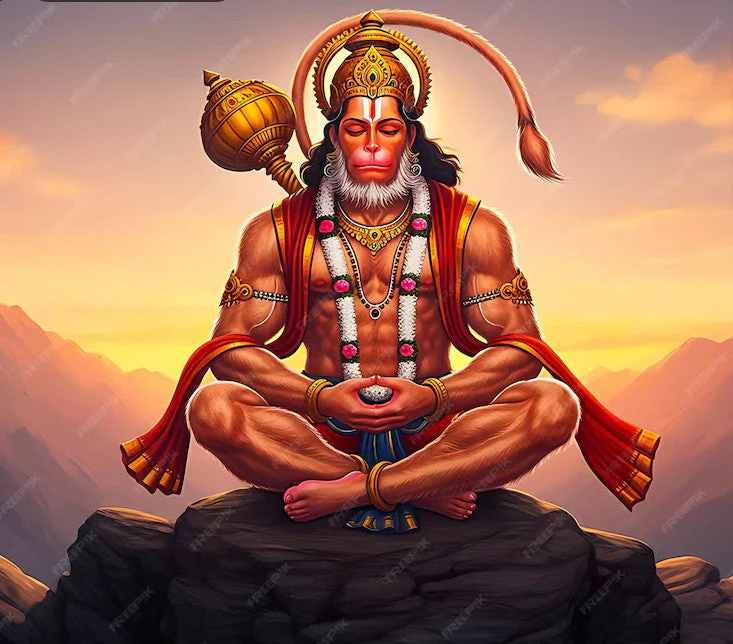
Lord Hanuman
The Eternal Devotee of Lord Rama — Embodiment of Strength, Courage and Selfless Service.
Learn more
Lord Vinayaka
The Preserver of the Universe — the all-pervading Supreme Being who descends to Earth in divine avatars whenever righteousness declines and evil rises.
Learn more