About Durga Puja
Last updated:
Durga Puja is undoubtedly the greatest festival of Bengal and one of the most spectacular religious celebrations in the world, recognised by UNESCO as an Intangible Cultural Heritage of Humanity in 2021. Observed during the Shukla Paksha of the month of Ashwin, the festival spans five days — Shashthi, Saptami, Ashtami, Navami, and Vijayadashami — and is a breathtaking fusion of religious devotion, artistic grandeur, community spirit, and cultural pride. In 2026, Durga Puja runs from 22 October (Saptami) to 26 October (Vijayadashami). The festival celebrates the homecoming of Goddess Durga to her parental abode — the earth — accompanied by her four divine children: Lakshmi, Saraswati, Kartikeya (Murugan), and Ganesha.
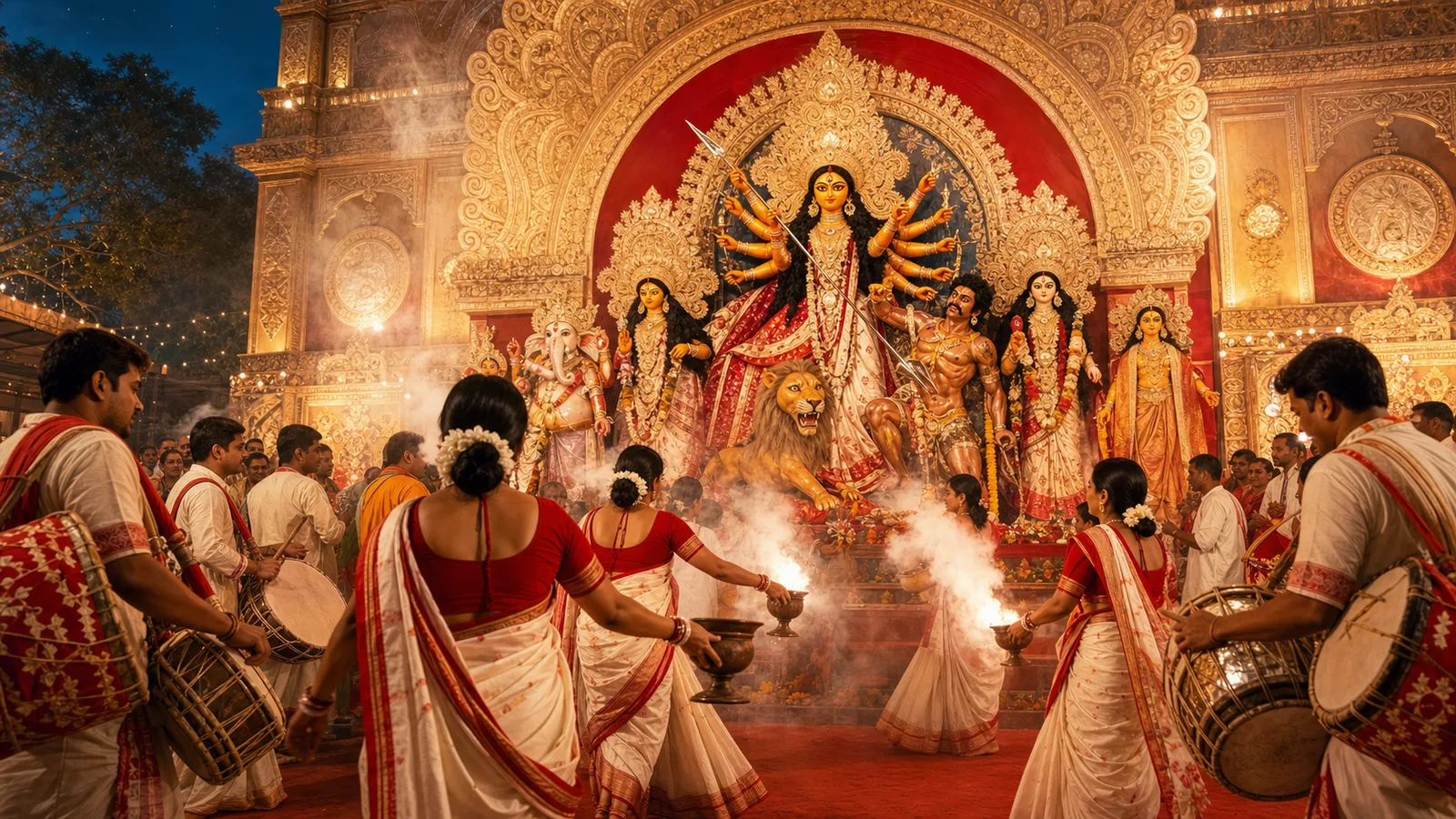
The physical centrepiece of Durga Puja is the pratima — a magnificent clay idol of Goddess Durga, ten-armed and mounted on a lion, depicted in the act of slaying the buffalo demon Mahishasura. These idols, crafted by skilled artisans (kumors) in the Kumortuli district of Kolkata using clay from the Ganges riverbed, are installed in elaborately decorated community pandals (temporary structures). The pandals themselves are architectural marvels — themed installations that can recreate ancient temples, international landmarks, or social commentary in painstaking detail, drawing millions of visitors in a phenomenon known as pandal hopping. The air is filled with the sound of dhak (traditional drums), the fragrance of dhuno (incense) and shiuli flowers, and the chanting of Sanskrit shlokas.
Beyond the religious rituals, Durga Puja is a time of unparalleled cultural efflorescence. New clothes (puja parikha) are bought and worn, family members separated by distance return home, and communities come together in a spirit of collective joy that transcends caste, class, and religion. The festival ends on Vijayadashami with the deeply emotional bidai — the farewell of the Goddess — as her idol is carried in a procession to the nearest river or water body for immersion (visarjan), accompanied by the ululation of conch shells, the beat of dhak drums, and the poignant cries of devotees saying goodbye to their divine daughter until next year.
Significance of Durga Puja
Durga Puja carries layered spiritual, cultural, and social significance that makes it unique among Hindu festivals:
Divine Triumph Over Evil: At its theological core, Durga Puja celebrates the Goddess's destruction of Mahishasura, the shape-shifting buffalo demon who had conquered the three worlds and driven the gods from heaven. Unable to defeat him individually, the gods pooled their divine energies to create Durga — the invincible mother warrior. Her victory on Vijayadashami is the eternal affirmation that truth, righteousness, and divine power always prevail over brute force and ego.
Shakti Philosophy: Durga Puja is the most elaborate expression of Shakta philosophy — the belief that the ultimate reality is feminine. The Goddess is not a consort but the supreme sovereign, the source from whom all male deities draw their power. Worshipping her in the form of a ten-armed warrior goddess acknowledges the universe's fundamental creative and protective principle.
Akalbodhan — Rama's Off-Season Invocation: According to the Ramayana tradition, Lord Rama invoked Goddess Durga in autumn (Sharad) — an unusual time, since her traditional worship season is spring (Vasanta). This 'unseasonable awakening' (akalbodhan) is re-enacted at every Durga Puja, linking the festival to the Ramayana and to Rama's victory over Ravana.
Social Renewal and Inclusion: Historically, Durga Puja served as a platform for social reform in Bengal, with leaders like Ram Mohan Roy and Rabindranath Tagore using it to challenge social inequities. Today, community pandals are financed collectively, ensuring that the festival belongs to everyone, regardless of wealth or status.
Homecoming (Agamani) and Farewell (Vijaya): On a deeply human level, the festival is the annual homecoming of a beloved daughter. The Goddess arrives with her children, is feted for five joyous days, and then departs — leaving behind the bittersweet emotion of a daughter's visit.
Deities worshipped on Durga Puja
Follow the links to explore each deity’s mantras, stories, and temples on Temples.bio.
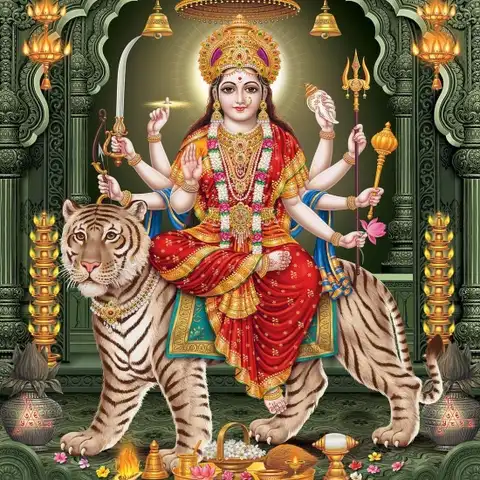
Goddess Durga
Supreme deity of the festival, worshipped as the ten-armed warrior goddess who slew Mahishasura
The Invincible Mother Goddess — Supreme Feminine Power who destroys evil, protects the righteous, and embodies the divine energy of the entire universe.
View deity →
Goddess Lakshmi
Durga's daughter, depicted to her right in the pratima, invoked for wealth and prosperity
The Invincible Mother Goddess — Supreme Feminine Power who destroys evil, protects the righteous, and embodies the divine energy of the entire universe.
View deity →
Goddess Saraswati
Durga's daughter, depicted to her left in the pratima, worshipped especially on Navami for learning and arts
The Invincible Mother Goddess — Supreme Feminine Power who destroys evil, protects the righteous, and embodies the divine energy of the entire universe.
View deity →Goddess Durga is the supreme deity of Durga Puja. In her dashabhuja (ten-armed) pratima form, she is depicted standing on a lion, spearing Mahishasura beneath her foot. Her ten arms carry weapons gifted by each of the male gods: the trishul (trident) from Shiva, the Sudarshana Chakra from Vishnu, the bow and arrows from Vayu and Surya, the thunderbolt from Indra, and the lotus from Brahma — symbolising that she encompasses and transcends all their powers.
Goddess Lakshmi stands to Durga's right in the traditional Bengali pratima grouping, holding lotus flowers and flanked by owls, representing wealth, prosperity, and auspiciousness.
Goddess Saraswati stands to Durga's left, holding a veena and books, representing learning, wisdom, and the arts. Her vehicle, the swan, perches beside her.
Lord Kartikeya (Murugan) stands to Durga's far right, the commander of the gods' armies, riding his peacock, representing valor and victory.
Lord Ganesha stands to Durga's far left, the remover of obstacles and lord of beginnings, ensuring the puja commences auspiciously.
Mahishasura appears at the base of the idol, half-man and half-buffalo, in his final moment of defeat — a reminder that arrogance and brute force cannot prevail against divine grace.
The lion (Durga's vahana) represents courage, strength, and the destruction of ego — the devotee's own inner demon to be vanquished.
How to celebrate Durga Puja 2026
A complete guide to observing Durga Puja rituals over five days:
1. Mahalaya (Pre-festival, Amavasya): Before the five main days, Mahalaya marks the Goddess's descent to earth. Bengalis wake before dawn to listen to the iconic All India Radio broadcast of Mahishasura Mardini — a devotional programme combining Sanskrit chants and classical songs. Tarpan (water offerings) are made to ancestors at riverbanks.
2. Shashthi (Day 1) — Bodhan and Amantran: The Goddess is formally awakened (bodhan) and invited (amantran) in an evening ritual at the pandal or home altar. The eyes of the clay idol are painted open (chakshu daan) in a ceremony of breathtaking significance, and the Goddess is considered to have arrived.
3. Saptami (Day 2) — Nabapatrika Snan: Early in the morning, a bundle of nine plants (nabapatrika) — banana, colocasia, turmeric, jayanti, bilva, pomegranate, ashoka, arum, and rice — tied together and draped in a white and red sari to represent the Goddess is taken to a riverbank for a ritual bath. This marks the formal beginning of the puja. Three days of elaborate pujas (Saptami, Ashtami, Navami puja) follow, with offerings of fruit, sweets, and flowers.
4. Ashtami (Day 3) — Sandhi Puja and Pushpanjali: The sandhi puja at the exact junction of Ashtami and Navami tithis (108 lamps lit, 108 lotus flowers offered) is the most sacred moment of the festival. Earlier in the day, devotees perform pushpanjali — offering handfuls of flowers to the Goddess while chanting mantras collectively.
5. Navami (Day 4) — Kumari Puja and Havan: Young pre-pubescent girls are worshipped as living embodiments of the Goddess (kumari puja). The day's grand havan (fire ceremony) with 108 ahutis concludes the main puja cycle.
6. Vijayadashami (Day 5) — Sindoor Khela and Visarjan: Married women smear sindoor (vermilion) on the Goddess and on each other in the joyful and poignant sindoor khela ceremony. Sweets are distributed. Then the idol is carried in a grand procession to the river for immersion (visarjan), with dhak drummers and conch-shell blowers leading the way. The farewell cry of "Asche bochor abar hobe" (It will happen again next year) echoes through the crowd.
Rituals & regional traditions
Durga Puja is celebrated with distinct regional and community traditions:
Kolkata — The Festival's Heartland:
- Over 2,500 community pujas (sarbojanin pujas) are held across the city, competing for the best pandal design, most innovative theme, and most beautiful idol.
- Pandal hopping — visiting as many pandals as possible across the five nights — is an integral cultural activity, with families and groups travelling by metro, bus, and on foot.
- Dhunuchi naach: a trance-like dance performed holding clay pots of burning coconut husks and incense, performed before the Goddess to the beat of dhak drums.
- Dhak (traditional barrel drums beaten with curved sticks) is the iconic sound of the festival; dhakis (drummers) are invited from villages across Bengal.
Sindoor Khela:
- On Vijayadashami morning, Bengali married women dress in white and red sarees, offer sindoor to the Goddess, smear it on her feet, and then playfully smear sindoor on each other's faces and hair — a joyful farewell tradition symbolising the blessings of a married woman.
Diaspora Celebrations:
- Bengali communities worldwide — in London, New York, Sydney, Singapore — organise Durga Puja pandals, bringing the festival to every continent.
North India and Other States:
- In cities like Delhi, Mumbai, and Varanasi, Bengali communities organise Durga Puja celebrations in local community halls and parks.
- In Mysore (Karnataka), the festival coincides with the grand Mysore Dasara state celebrations.
Traditional Bhog (Prasad):
- Khichuri (rice and lentils), labra (mixed vegetables), chutney, papad, and mishti doi (sweet yogurt) are prepared as bhog and distributed to all devotees as prasad.
Spiritual benefits
Observing Durga Puja with full devotion bestows these spiritual and worldly benefits:
- Victory over personal demons: Just as Durga slew Mahishasura, devoted worship helps devotees overcome their inner enemies — ego, anger, greed, lust, and fear.
- Divine protection: The Goddess's energy, invoked through five days of elaborate ritual, creates a protective shield around devotees and their families for the entire year.
- Fulfilment of material and spiritual desires: Sincere worship of Durga during her annual homecoming is said to grant health, wealth, a happy family, and liberation (moksha).
- Blessings of Lakshmi, Saraswati, Kartikeya, and Ganesha: Worshipping the entire divine family means receiving the combined grace of the gods of wealth, learning, victory, and auspicious beginnings.
- Ancestral merit: The Mahalaya tarpan offered to ancestors before the festival earns merit for departed souls, and the festival period is considered auspicious for remembering and honouring one's lineage.
- Community purification: The collective nature of sarbojanin (community) Durga Puja purifies the social environment, fosters unity, and creates shared positive karma.
- Emotional catharsis and renewal: The bittersweet farewell of the Goddess on Vijayadashami — known as the emotion of vijaya (victorious departure) — is a profound emotional experience that teaches devotees to embrace both joy and impermanence.
- Cultural pride and identity: For Bengalis worldwide, Durga Puja is a powerful anchor of cultural identity, reinforcing connections to language, heritage, and community.
Mantras & sacred chants
1. Mahishasura Mardini Shloka (from Durga Saptashati)
Sanskrit: ॐ जयन्ती मङ्गलाकाली भद्रकाली कपालिनी। दुर्गा क्षमा शिवा धात्री स्वाहा स्वधा नमोऽस्तु ते।
Transliteration: Om Jayanti Mangala Kali Bhadrakali Kapalini, Durga Kshama Shiva Dhatri Swaha Swadha Namo'stu Te.
Meaning: "Salutations to You — the Victorious One, the Auspicious One, Kali, Bhadrakali, the skull-bearing one, Durga, the Forgiving one, Shiva, the Sustainer, the oblation-fire, the ancestral offering."
2. Pushpanjali Mantra (chanted during flower offering)
Sanskrit: ওঁ জয়ন্তী মঙ্গলা কালী ভদ্রকালী কপালিনী। দুর্গা ক্ষমা শিবা ধাত্রী স্বাহা স্বধা নমোহস্তু তে।
Transliteration: Om Namah Chandikayai — Esha Pushpanjalih
Meaning: The pushpanjali mantra offered while presenting flowers to the Goddess during the collective morning ritual. Devotees cup flowers in both hands, raise them to their foreheads, and release them at the Goddess's feet.
3. Devi Suktam (Rig Veda X.125)
Sanskrit: अहं रुद्रेभिर्वसुभिश्चराम्यहमादित्यैरुत विश्वदेवैः।
Transliteration: Aham Rudrebhir Vasubhish Charamy, Aham Adityair Uta Vishvadevaih.
Meaning: "I move with the Rudras and the Vasus, with the Adityas and the Vishvadevas." This ancient Rig Vedic hymn spoken in the voice of Devi herself is considered the source of all Shakta philosophy and is recited at the start of the Durga Puja.
Durga Puja 2026 — FAQs
Durga Puja 2026 begins on 22 October 2026 (Saptami) and concludes on 26 October 2026 (Vijayadashami). Mahalaya, which marks the start of the festival period, falls on 17 October 2026.
Both festivals honour Goddess Durga during Ashwin Shukla Paksha, but they are celebrated differently. Navratri spans nine nights and is observed pan-India with fasting, garba, and Navadurga worship — most grandly in Gujarat and North India. Durga Puja is the specifically Bengali celebration of the last five days of Navratri, characterised by clay idols in pandals, dhak drumming, sindoor khela, and communal feasting.
Pandal hopping refers to the tradition of visiting multiple community Durga Puja pandals (elaborately themed temporary structures housing the Goddess's idol) across the city during the five festival days. In Kolkata alone, over 2,500 pandals are set up, each competing with unique artistic themes — from ancient temples to international landmarks to social commentary installations.
Sindoor Khela is a joyful ritual on Vijayadashami (the final day) in which married Bengali women, dressed in traditional white and red sarees, offer sindoor (vermilion) to Goddess Durga, smear it on her feet and face, and then playfully apply sindoor to each other. It is a symbol of marital bliss and a fond farewell to the Goddess before her idol is immersed.
Mahalaya marks the beginning of Devi Paksha (the fortnight of the Goddess) and is observed on the Amavasya (new moon) before Durga Puja. Devotees wake before dawn to listen to Mahishasura Mardini — a celebrated All India Radio broadcast of Sanskrit hymns and devotional songs. Tarpan (water libations to ancestors) is offered at riverbanks. Mahalaya signals that Goddess Durga has begun her descent to earth.
Traditional Durga Puja bhog (prasad) includes khichuri (a savoury preparation of rice and lentils), labra (a mixed-vegetable dish), begun bhaja (fried eggplant), chutney, papad, and mishti doi (sweet yogurt). This bhog is prepared on Ashtami and Navami and distributed to all devotees. Many community pujas serve thousands of people from a common kitchen.
UNESCO inscribed Durga Puja on its Representative List of the Intangible Cultural Heritage of Humanity in December 2021, citing it as a unique festival that brings together urban communities, artists, craftspeople, and millions of people in a shared creative and spiritual experience. The festival was recognised for its artistic innovation (pandal design), its democratic and inclusive community ethos, and its role in preserving living craft traditions such as clay idol-making in Kumortuli.
Durga Puja 2025 runs from 2 October (Saptami) to 5 October (Vijayadashami). Durga Puja 2027 runs from 12 October (Saptami) to 16 October (Vijayadashami).