About Rath Yatra
Last updated:
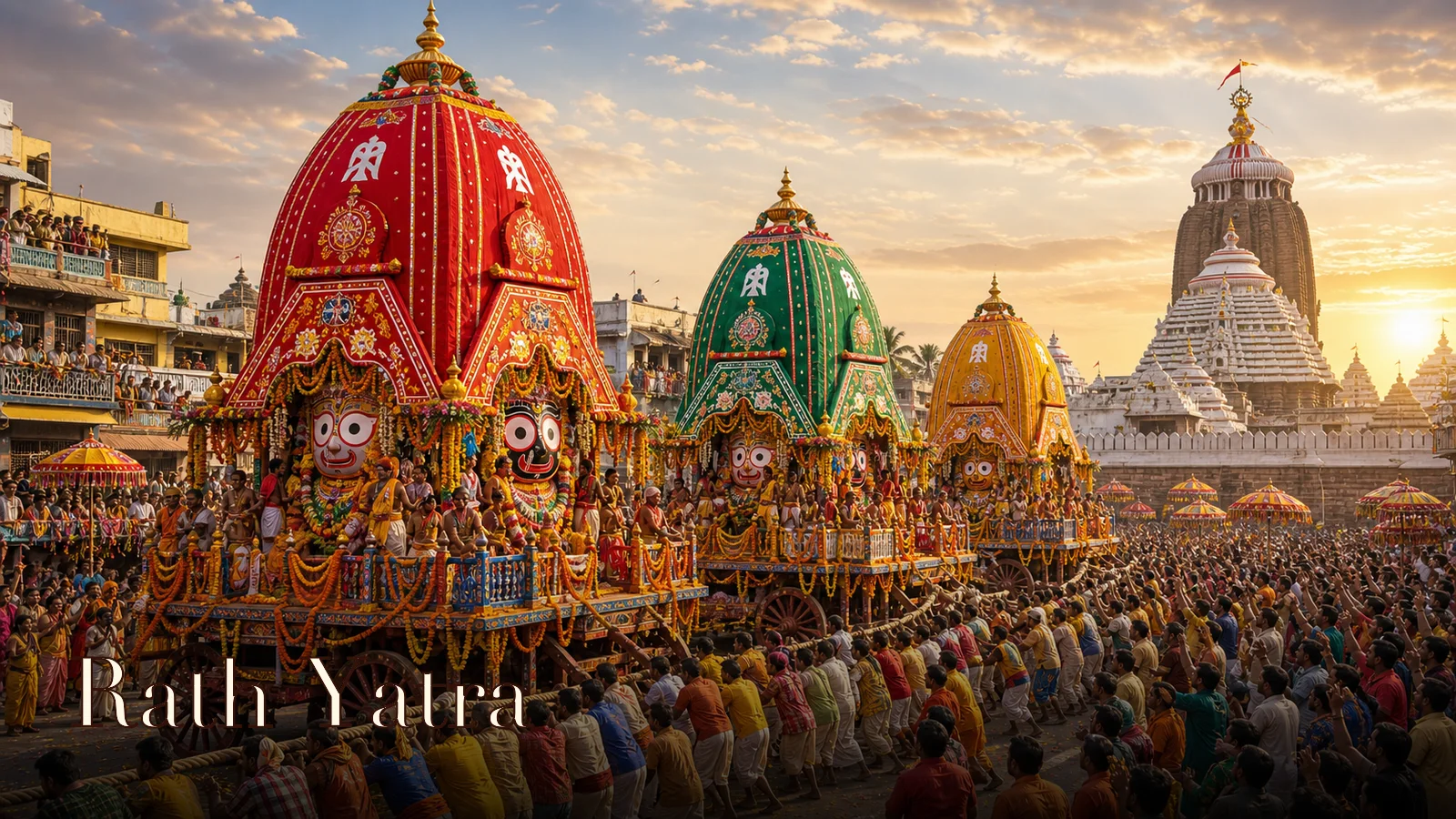
Rath Yatra, the Festival of Chariots, is one of the oldest and most spectacular religious festivals in the world. Celebrated on the second day (Dwitiya) of the bright fortnight (Shukla Paksha) of the Ashadha month, it marks the annual journey of Lord Jagannath — a form of Lord Vishnu or Krishna — from his temple in Puri to the Gundicha temple, accompanied by his siblings Balabhadra (elder brother) and Subhadra (sister). The three deities ride on enormous, elaborately decorated wooden chariots that are freshly constructed every year by skilled craftsmen. The Puri Rath Yatra in Odisha is the most famous, drawing millions of pilgrims and tourists from across and the world. The main chariot of Lord Jagannath, called Nandighosa, stands approximately 14 metres (45 feet) tall with 16 wheels, while Balabhadra's chariot Taladhwaja and Subhadra's chariot Darpadalana are slightly smaller. The pulling of these chariots by devotees using thick ropes is considered an act of supreme devotion — even touching the ropes is believed to bestow the merit of a hundred sacrifices (yajnas). The 14th-century traveller Ibn Battuta and the Vaishnava saint Chaitanya Mahaprabhu both witnessed and participated in this great festival. The deities stay at the Gundicha temple for nine days, after which the return journey — called Bahuda Yatra — brings them back to the main Jagannath Temple. During the return journey, the chariots halt at the Mausi Ma temple where the deities are offered Poda Pitha (a traditional Odishan cake). Rath Yatra is also celebrated in many cities across and internationally by ISKCON communities as the Chariot Festival, carrying the message of Lord Krishna's universal accessibility to all, regardless of caste or creed.
Significance of Rath Yatra
Rath Yatra holds extraordinary spiritual, social, and cultural significance that has made it one of 's most iconic festivals. - Universal Accessibility: Uniquely among Hindu festivals, the Rath Yatra allows every person — regardless of caste, gender, or ritual status — to have darshan of Lord Jagannath and even touch his chariot. This radical inclusivity is central to the festival's message. - Jagannath as Universal Lord: The name Jagannath means "Lord of the Universe." His form — with large eyes, no arms or legs, and an unfinished appearance — is seen as a symbol of the formless Supreme Being taking the most accessible form possible for his devotees. - The Deity's Compassion: The annual journey to Gundicha temple is interpreted as the Lord coming out of his sacred abode to give darshan to all beings, not just those who can afford to enter the inner sanctum. - Chaitanya's Legacy: Sri Chaitanya Mahaprabhu spent his later years in Puri and participated in the Rath Yatra with ecstatic devotion, making it central to the Gaudiya Vaishnava tradition worldwide. - Social Significance: The King of Puri (Gajapati King) sweeps the chariots with a golden broom (Chhera Pahanra), demonstrating that in the eyes of the Lord, even a king is a servant — a powerful message of social equality. - Agricultural Connection: The journey coincides with the monsoon season when the earth is being renewed; the Lord's journey is seen as a cosmic act of blessing the land and its people.
Deities worshipped on Rath Yatra
Follow the links to explore each deity’s mantras, stories, and temples on Temples.bio.
Lord Krishna
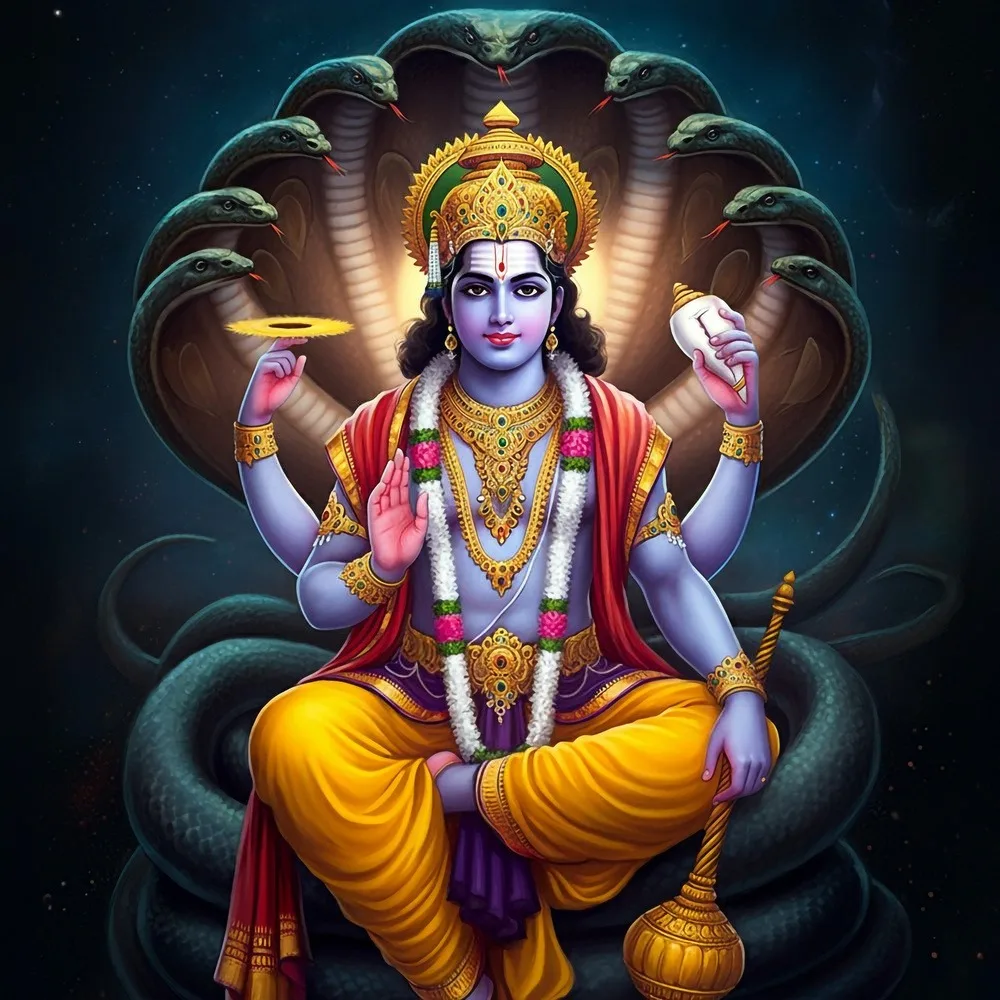
Lord Jagannath is a form of Lord Krishna, the presiding deity of Rath Yatra
The Preserver of the Universe — the all-pervading Supreme Being who descends to Earth in divine avatars whenever righteousness declines and evil rises.
View deity →
Lord Vishnu
Jagannath is also worshipped as an avatar of Vishnu in Vaishnava tradition
The Preserver of the Universe — the all-pervading Supreme Being who descends to Earth in divine avatars whenever righteousness declines and evil rises.
View deity →Lord Jagannath is the presiding deity of Rath Yatra. Jagannath is worshipped as a form of Lord Vishnu or Lord Krishna in the Vaishnava tradition, though his origins may include pre-Vedic tribal traditions of Odisha. His distinctive iconography — large circular eyes, no clearly defined arms or legs, and a half-finished wooden form — is said to represent Brahman in its most universally accessible form. The wooden idols are renewed every twelve years in the Nabakalebara ceremony.
Lord Balabhadra, the elder brother of Jagannath, represents Balarama (Krishna's elder brother) or Shiva in different theological interpretations. He rides the chariot Taladhwaja adorned with white and blue decorations. Balabhadra embodies strength, protection, and dharmic authority.
Goddess Subhadra, sister of Jagannath and Balabhadra, is identified with Yoga Maya or Parvati. She rides the chariot Darpadalana adorned with red and black colours. Her presence completes the divine trinity that represents creation, preservation, and dissolution.
Sudarshana, the divine discus of Lord Vishnu, also accompanies the procession as a fourth element, riding on Balabhadra's chariot. Together, the three deities and Sudarshana represent the complete cosmic order under the benevolent gaze of Lord Jagannath.
How to celebrate Rath Yatra 2026
How to Observe and Participate in Rath Yatra:
1. If visiting Puri, arrive early — the chariot procession typically begins in the late morning after rituals; millions attend so plan for crowds.
2. At home or in your city, wake up early, bathe, and set up a puja altar with images of Lord Jagannath, Balabhadra, and Subhadra.
3. Offer yellow flowers, tulsi, coconut, bananas, and seasonal fruits to the deities.
4. Prepare or offer Mahaprasad — the sacred food of Lord Jagannath (rice, dal, vegetables cooked without onion and garlic) — as it is considered supremely purifying.
5. Chant the Jagannath Ashtakam, Hare Krishna Mahamantra, or "Jai Jagannath" repeatedly throughout the day.
6. If a local Rath Yatra procession is organised in your city (ISKCON and Vaishnava organisations conduct these worldwide), participate in pulling the chariot rope.
7. Read or listen to the stories of Lord Jagannath from the Skanda Purana (Utkal Khanda) or Jagannath Charitramrta.
8. Perform Annadaan — donate food, especially Mahaprasad-style cooked food — to pilgrims and the needy.
9. On Bahuda Yatra (the return journey, nine days later), repeat the puja and celebrate the Lord's return.
10. Fast or observe dietary restrictions (no onion, garlic) throughout the day as a mark of devotion.
Rituals & regional traditions
- Snana Yatra (Bathing Festival) precedes Rath Yatra by fifteen days; the deities are ceremonially bathed and then remain in Anavasara (rest) before reappearing for the chariot festival.
- Chhera Pahanra: The Gajapati King of Puri sweeps the chariot with a golden broom, demonstrating royal humility before the Lord.
- Chariot Construction: New chariots are built every year from specific types of wood (phasi, dhausa, puni, and other trees) by traditional artisans; no nails are used — the chariots are assembled entirely with wooden pegs and ropes.
- In ISKCON temples worldwide, Rath Yatra is celebrated with decorated floats, kirtans, and distribution of Mahaprasad to thousands.
- Gundicha Temple Visit: The deities stay at Gundicha temple (considered the garden home or maternal aunt's house) for nine days; devotees visit for darshan during this period.
- Bahuda Yatra: The return procession is equally celebrated; the chariots stop at the Mausi Ma temple for offerings of Poda Pitha before the deities return to the main temple.
- In West Bengal, the festival is celebrated as Ulto Rath (reverse chariot) on Bahuda Yatra day with great fervour in many towns.
- Tribal traditions from Odisha's indigenous communities have influenced Jagannath worship, making Rath Yatra a rare confluence of Vedic and tribal religious heritage.
Spiritual benefits
- Pulling the rope of Lord Jagannath's chariot even once is said to bestow the merit of performing a hundred Ashwamedha yajnas (horse sacrifices).
- Darshan of Lord Jagannath on his chariot liberates the soul from the cycle of birth and death (samsara).
- Participating in Rath Yatra is believed to fulfil unfulfilled desires and grant the sincere devotee's heartfelt wishes.
- Consuming Mahaprasad of Lord Jagannath purifies the physical body, the subtle body, and the karmic field of the devotee.
- Donating food, clothes, or money during Rath Yatra multiplies the charitable merit manifold due to the cosmic significance of the day.
- Chanting the Hare Krishna Mahamantra or Jagannath Ashtakam during the festival awakens devotion and calms the mind.
- The act of pulling the chariot rope together with millions of other devotees creates a powerful collective spiritual energy that elevates all participants.
- The festival teaches that the Lord belongs to everyone equally, dissolving the illusion of separateness and awakening universal love.
Mantras & sacred chants
Mantra 1 — Jagannath Ashtakam (Opening Verse):
Sanskrit: कदाचित् कालिन्दी-तट-विपिन-सङ्गीत-तरलो मुदाभीरी-नारी-वदन-कमला-स्वाद-मधुपः। रमा-शम्भु-ब्रह्मामर-पति-गणेशार्चित-पदो जगन्नाथः स्वामी नयन-पथ-गामी भवतु मे॥
Transliteration: Kadachit Kalindi-tata-vipina-sangita-taralo Muda-bhiri-nari-vadana-kamala-svada-madhupah, Rama-shambhu-brahhamara-pati-ganesharchita-pado Jagannathah Svami Nayana-patha-gami Bhavatu Me
Meaning: May Lord Jagannath, who once played his enchanting music on the banks of the Yamuna, who tasted the lotus-faces of the Gopi women with joy, and whose feet are worshipped by Lakshmi, Shiva, Brahma, Indra, and Ganesha — may he appear on the path of my eyes.
Mantra 2 — Hare Krishna Mahamantra:
Sanskrit: हरे कृष्ण हरे कृष्ण कृष्ण कृष्ण हरे हरे। हरे राम हरे राम राम राम हरे हरे॥
Transliteration: Hare Krishna Hare Krishna Krishna Krishna Hare Hare, Hare Rama Hare Rama Rama Rama Hare Hare
Meaning: O Lord Krishna, O Lord Rama, O Divine Energy — please engage me in your service. This mahamantra cleanses the mirror of the mind and extinguishes the fire of material suffering.
Mantra 3 — Jagannath Invocation:
Sanskrit: ॐ नमो भगवते जगन्नाथाय
Transliteration: Om Namo Bhagavate Jagannathaya
Meaning: I bow to Lord Jagannath, the Lord of the Universe, the Supreme Personality of Godhead.
Rath Yatra 2026 — FAQs
Rath Yatra 2026 falls on Thursday, July 16, 2026, on the Dwitiya tithi of Ashadha Shukla Paksha. Bahuda Yatra (the return journey) falls on Friday, July 24, 2026.
The most famous Rath Yatra is celebrated at the Jagannath Temple in Puri, Odisha. It attracts millions of pilgrims every year and is one of the largest religious gatherings in the world.
Rath Yatra symbolises Lord Jagannath's compassion in coming out of his temple to give darshan to all devotees regardless of caste or creed. Pulling the chariot rope is believed to grant the merit of a hundred yajnas.
The three chariots are: Nandighosa (Lord Jagannath's chariot, 16 wheels), Taladhwaja (Lord Balabhadra's chariot, 14 wheels), and Darpadalana (Goddess Subhadra's chariot, 12 wheels).
Bahuda Yatra is the return chariot procession, nine days after Rath Yatra, when the deities of Jagannath, Balabhadra, and Subhadra return from Gundicha temple to the main Jagannath Temple in Puri.
ISKCON temples worldwide celebrate Rath Yatra with decorated floats, Hare Krishna kirtans, and distribution of free Mahaprasad. Large Rath Yatras are held in Kolkata, Mumbai, Delhi, London, New York, and Toronto.
Yes, Rath Yatra is one of the most inclusive Hindu festivals. Devotees of all faiths are welcome to pull the chariot rope and receive Mahaprasad. Lord Jagannath is considered the Lord of the Universe, welcoming all.
Mahaprasad is the sacred food cooked in the Jagannath Temple kitchen, considered the most purifying prasad in Hinduism. It is cooked in earthen pots over wood fire and includes rice, dal, and vegetable preparations without onion or garlic.
Gundicha Marjana (ceremonial cleaning of the Gundicha Temple) is on July 15, 2026. The main Rath Yatra (chariot procession to the Gundicha Temple) is on Thursday, July 16, 2026. Hera Panchami falls on July 20, Sandhya Darshan on July 23, Bahuda Yatra (return journey) on July 24, Suna Besha (golden-attire darshan) on July 25, Adhara Pana on July 26, and Niladri Bije (the deities re-enter the main temple) on July 27, 2026.
On July 16, 2026 the morning rituals — Mangala Aarti, the Pahandi (ceremonial procession of the deities onto the chariots) and the Chhera Pahanra (the Gajapati King sweeping the chariots with a golden broom) — are completed by midday. The pulling of the three chariots along the Grand Road (Bada Danda) towards the Gundicha Temple then begins, usually in the afternoon.
Bahuda Yatra, the return chariot procession from the Gundicha Temple back to the main Jagannath Temple, falls on Friday, July 24, 2026. It is followed by Suna Besha (the golden-attire darshan of the deities on the chariots) on July 25 and Niladri Bije, the deities re-entry into the temple, on July 27, 2026.